You found a blank wall in the living room, and it has stayed empty for months. You want to hang a beautiful canvas, but you hesitate every time you look at sizes online. Choose a painting that is too small and it looks lost and lonely. Pick something too large and it swallows the room, and you are stuck arranging a return for a box the size of a door.
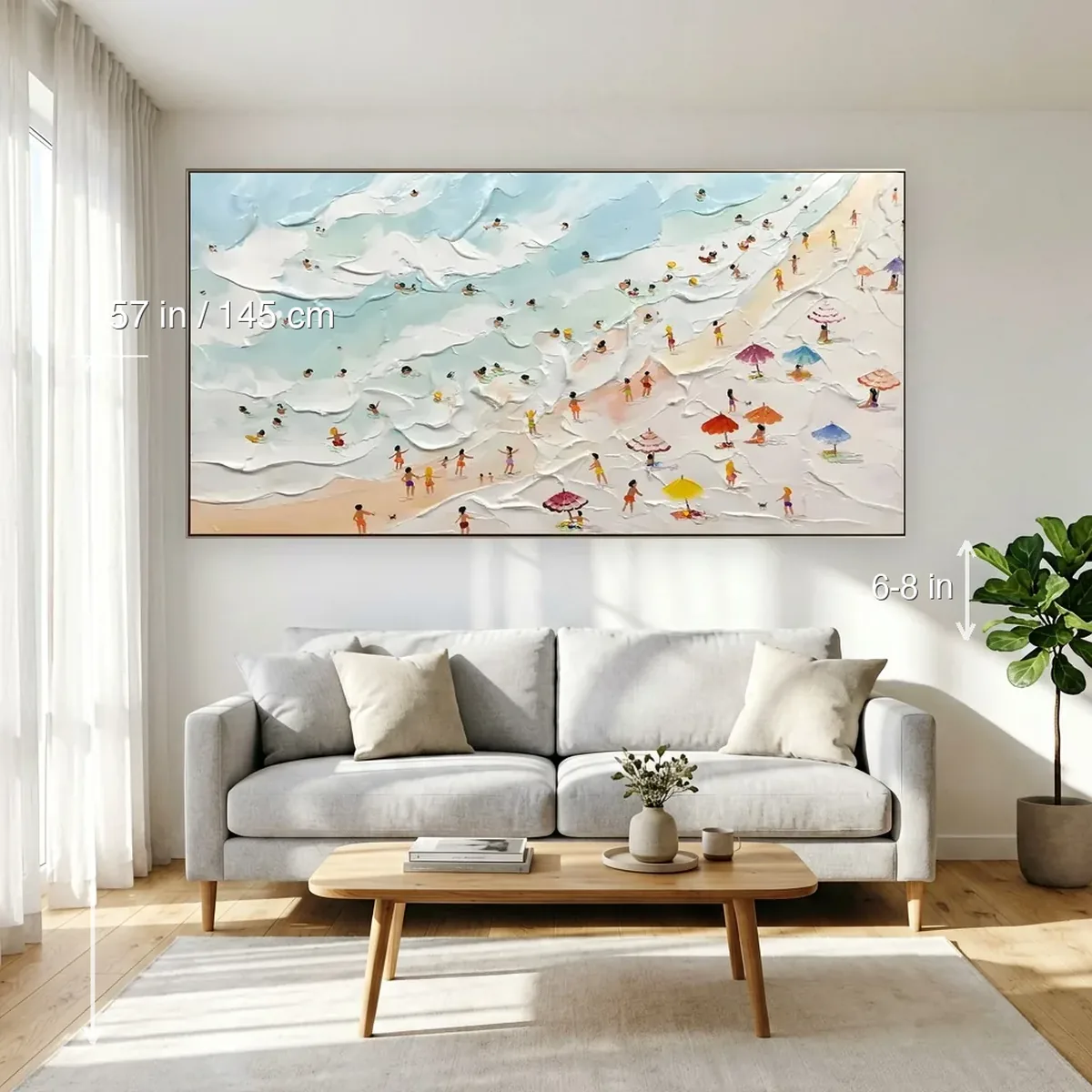
Here is the core rule that solves it: the wall art should span about two-thirds the width of the furniture below it, and the center of the canvas should hang 57 inches (145 cm) from the floor.
What’s the rule for choosing painting size?
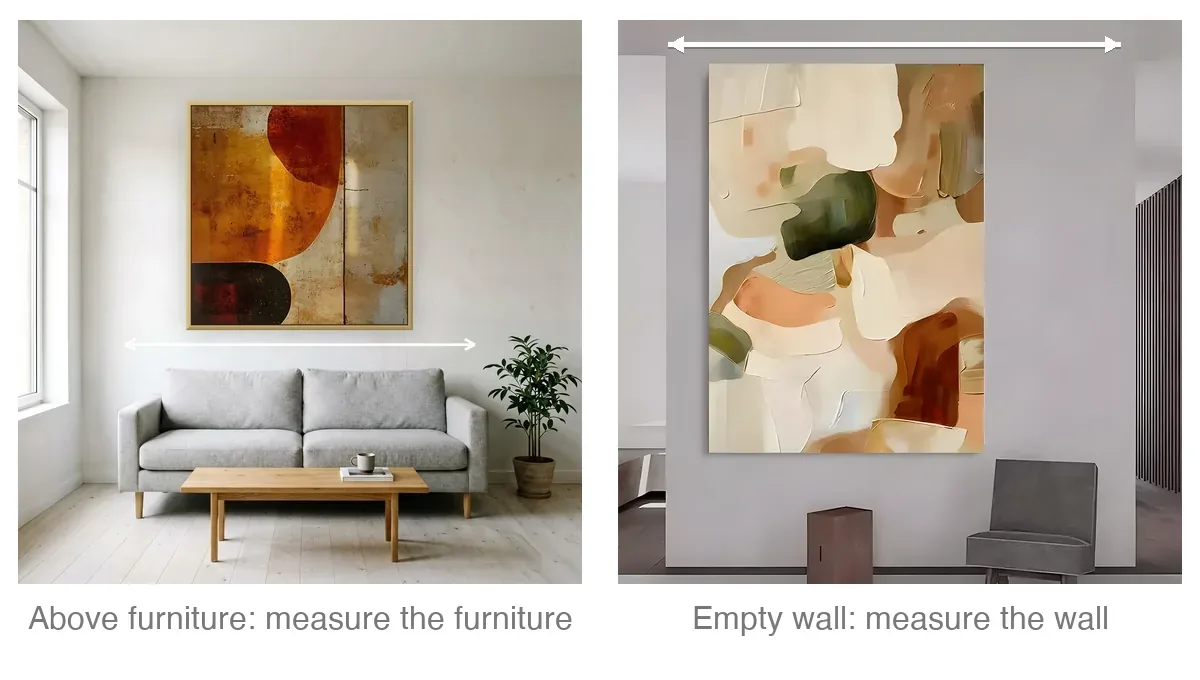
To find the right size, you only need to answer one question: is there furniture directly under the spot where you want the art?
If you are hanging above furniture, use the furniture rule. Take the width of the sofa, bed, or console and multiply it by 0.66 to 0.75; your painting should land between those two numbers. A 60-inch (152 cm) console, for example, wants art between 40 and 45 inches (102 to 114 cm) wide.
If you are hanging on an empty wall with nothing below it, use the empty-wall rule. Measure the full width of the wall and multiply by 0.57. A 100-inch (254 cm) hallway wall wants a piece around 57 inches (145 cm) wide, which leaves balanced space on either side instead of one small painting stranded in the middle.
Let’s start with the wall you are probably here for.
What size painting goes above a sofa?
The wall above the sofa is the main focal point of the living room, and it’s the one you are most likely worried about. To make it feel balanced, the artwork should span two-thirds to three-quarters of the sofa’s width.
One thing designers agree on: don’t go wider than the sofa itself. Art that overhangs the arms makes the whole wall feel top-heavy, like it’s about to crush the seat. (The one exception is a room with a very high ceiling, where you can push toward three-quarters or a touch more to fill the vertical space.)
| Sofa width | Ideal art width | What it looks like |
|---|---|---|
| 72 in / 183 cm (loveseat) | 48 to 54 in / 122 to 137 cm | Frames the seating without spilling over the arms |
| 84 in / 213 cm (3-seater) | 56 to 63 in / 142 to 160 cm | Anchors the center of the room |
| 96 in / 244 cm (large sofa) | 64 to 72 in / 163 to 183 cm | A bold statement that matches the couch’s scale |
| 110 in+ / 280 cm+ (sectional) | 80 in+ / 203 cm+ | Fills the visual weight of a modular couch |
If you own a sectional, don’t measure the whole length including the chaise that juts into the room. Measure only the straight run of seating flat against the wall, and lean toward the larger end.
When you pick art for this wall, a single large canvas looks cleaner than a cluster of small prints. One big hand-painted piece gives you a continuous texture that holds your eye, while too many small frames just read as clutter.
What size painting goes above a bed?
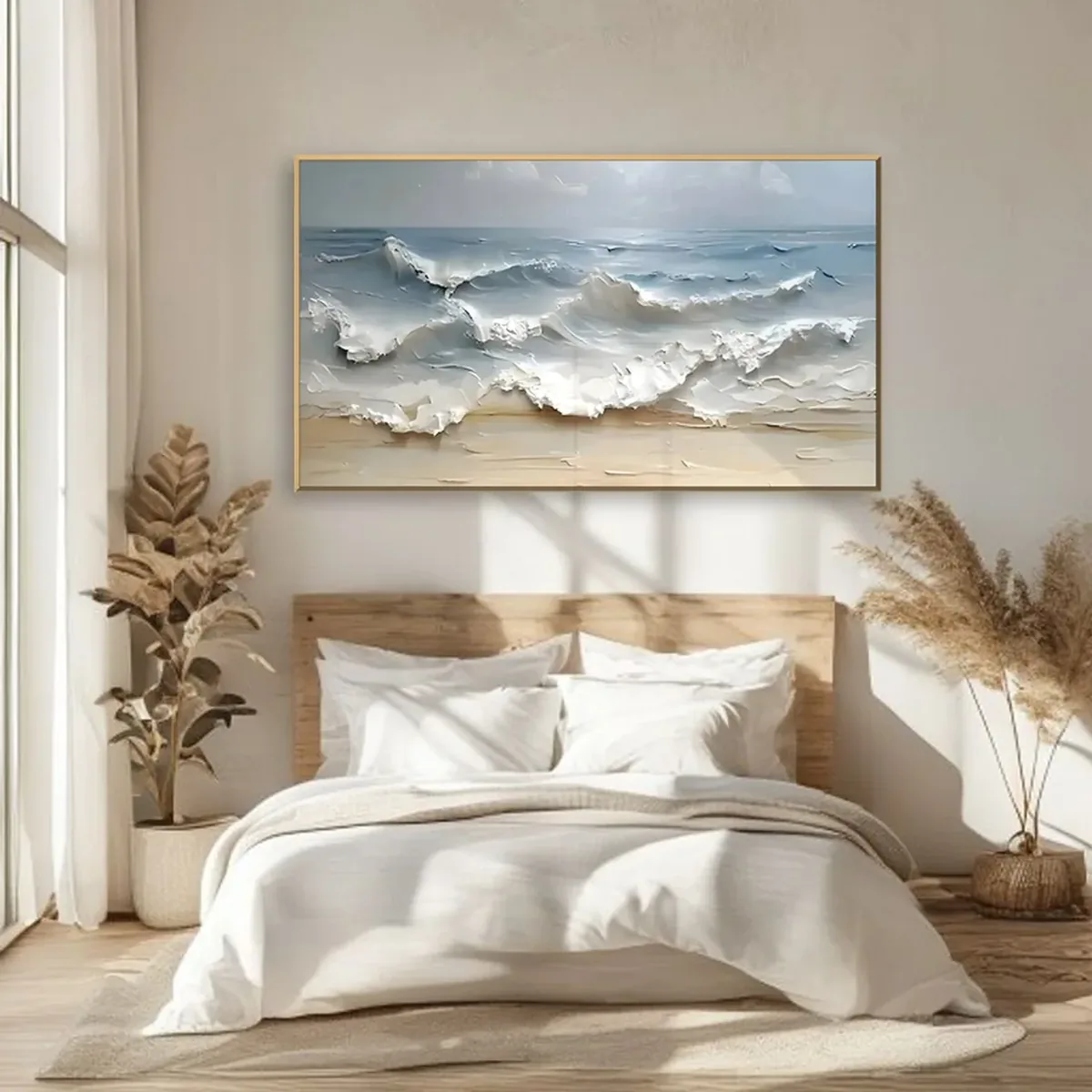
In the bedroom, the headboard is the anchor. Instead of measuring the wall, use the width of the bed frame.
For a queen bed, about 60 inches (152 cm) wide, look for art between 40 and 45 inches (102 to 114 cm) wide. For a king bed, about 76 inches (193 cm) across, aim for 50 to 57 inches (127 to 145 cm).
Horizontal formats work best here, because they echo the low, wide line of the bed. Choose calmer themes and softer brushwork to keep the room restful. When you hang it, leave the bottom edge 8 to 10 inches (20 to 25 cm) above the headboard, so you don’t knock the frame when you sit up to read.
What size art goes above a fireplace or console?
A fireplace has its own architectural line to work with. Don’t measure the full width of the mantel shelf; measure the firebox opening instead. Sizing your art to that opening keeps it in proportion with the fire, where sizing it to the wide mantel usually leaves it looking bloated.
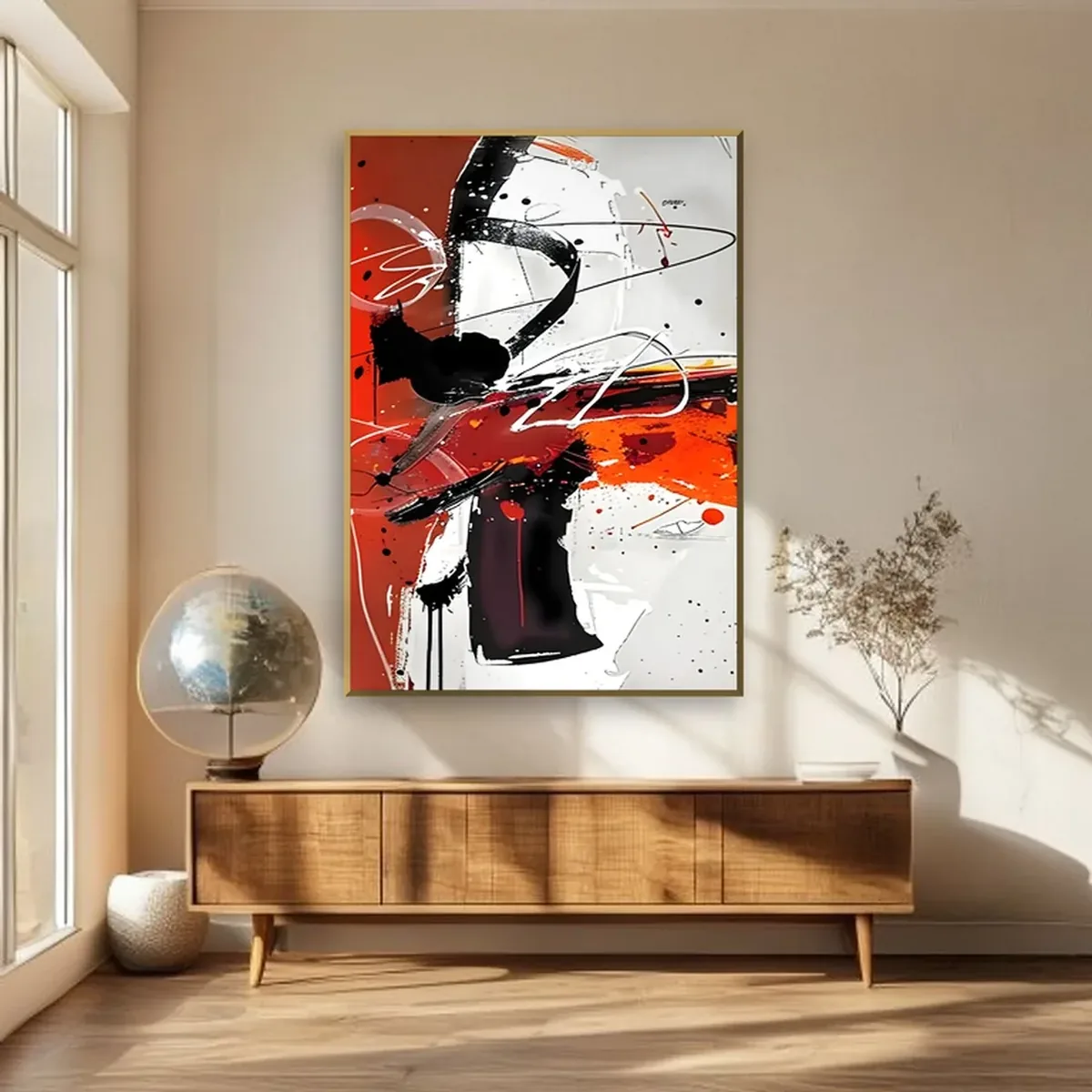
For an entryway console or a dining sideboard, go back to the two-thirds rule: measure the tabletop and fill about 66% of that width. An entryway is also a great spot for a vertical canvas, which draws the eye upward and makes a low ceiling feel higher than it is.
What size art for a staircase, dining room, or office?
The sofa, bed, and fireplace cover most walls, but a few spots need their own quick answer.
Staircase wall. A staircase can feel chaotic because the floor keeps stepping up. To bring order to it, hang a series of mid-sized pieces so the center of each one sits 57 inches (145 cm) above the step directly beneath it. The canvases climb in a smooth diagonal that follows your stairs. Keep the gap between frames the same, 2 to 3 inches (5 to 8 cm).
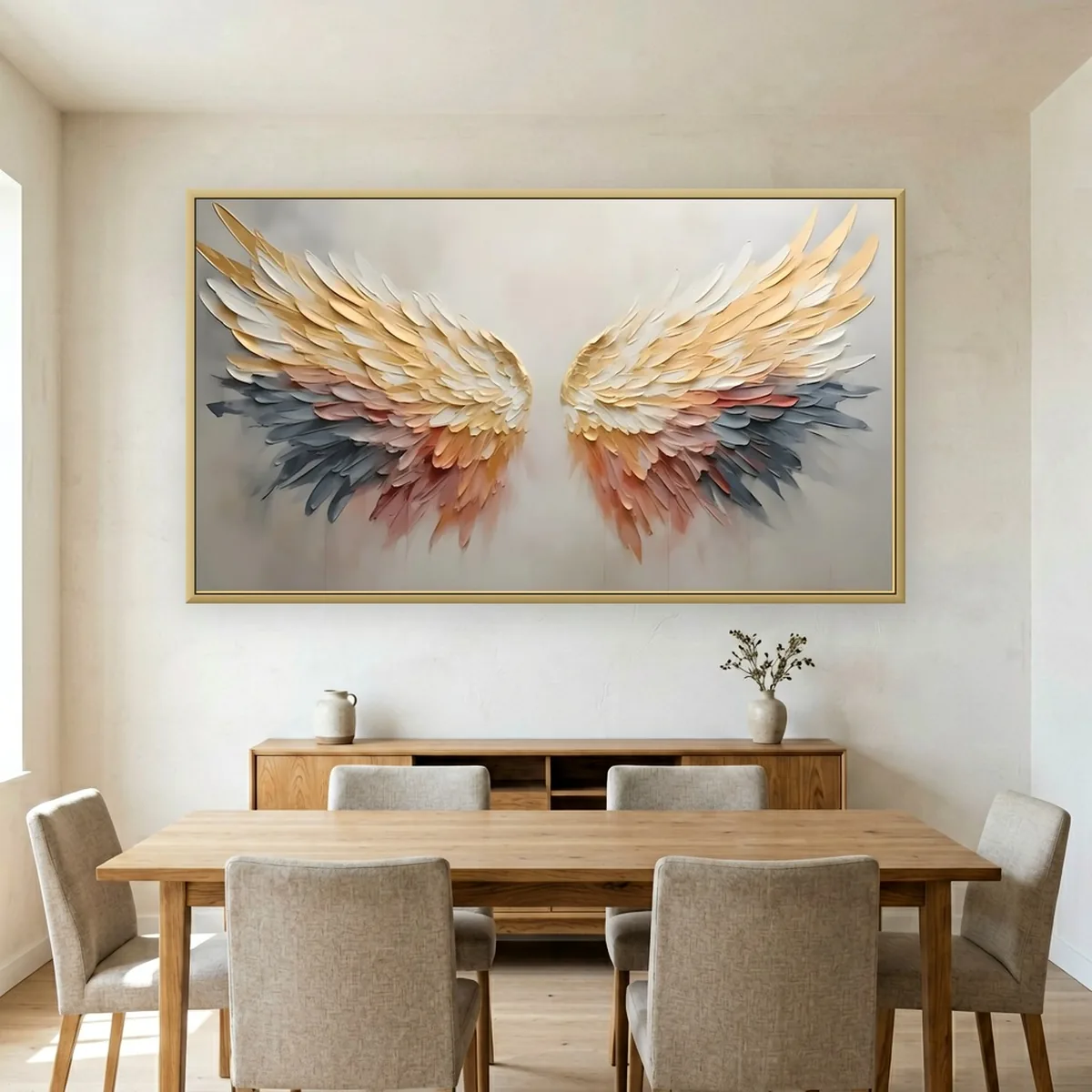
Dining sideboard. Fill two-thirds of the sideboard width, and feel free to go bolder here than you would in a bedroom, with heavier texture or stronger color, because nobody needs to fall asleep next to the buffet. Browse our dining room paintings sized for this wall.
Home office. You have two walls to think about. Above the desk, a modest 24 to 36 inch (61 to 91 cm) piece works without crowding you. The other is the one everybody forgets: the wall behind you on video calls. Pick something big enough to stay recognizable through a webcam, roughly 30 inches (76 cm) or wider, with bold strokes rather than tiny details that turn to blurry dots on screen. Our home office collection is filtered for both.
Hallway. A wide horizontal painting can make a narrow hall feel like it’s closing in. Use vertical canvases on small accent walls instead, or hang a repeating row of same-size pieces down the length of the hall for a steady rhythm, every center at 57 inches (145 cm). See what fits in our hallway paintings.
Why the same artwork dimensions can look bigger (or smaller)
By now you have a number for the wall. But that’s not all. Artwork dimensions are only half of how big a painting feels. The other half is contrast.
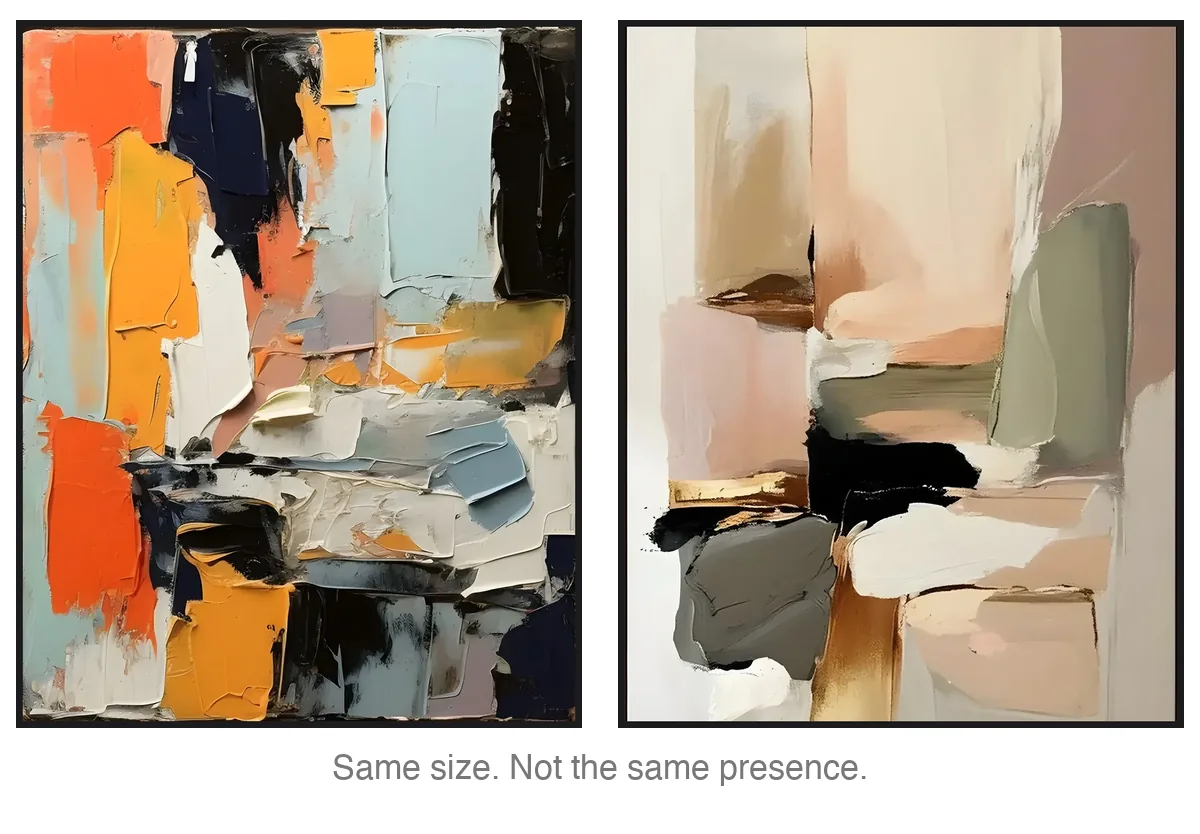
A painting with dark, high-contrast color and thick palette-knife texture feels visually heavy. It commands attention and fills a wall fast, so if you choose a piece like that, stay at the lower end of your size range. A soft, airy piece in gentle tones behaves almost like a neutral wall; it reads lighter, so you can push toward the top of your range without the room feeling cramped.
So treat your calculated range as a dial: size bold, high-contrast art small, and soft, calming art large.
One small thing the charts skip: if your piece is framed, measure to the outside of the frame, not the canvas. Our floater frames are slim and add only about half an inch (1 to 2 cm) per side, so they barely change the math, but a chunky frame would, so it’s worth a quick check before you buy.
How high should you hang a painting?
The standard is to place the center of the canvas 57 inches (145 cm) from the floor. That’s average human eye level, the height galleries and museums use. The most common mistake is hanging art much too high, which forces people to crane their necks.
When you use the 57-inch (145 cm) center above a standard sofa or console, it naturally puts the bottom edge of the frame about 6 to 8 inches (15 to 20 cm) above the furniture, so the two read as one connected unit instead of drifting apart.
Before you hammer a nail into the wall, test the size. Cut a piece of brown packing paper or cardboard to the exact dimensions of the painting, tape it up with painter’s tape, and leave it for two days. You’ll see the true scale as you move through the room during a normal day.
How do you size a gallery wall?
A gallery wall combines several smaller pieces into one display, and the trick to making it look deliberate is to treat the whole cluster as a single artwork. Measure the outer edges of the entire group; that total width should still follow the two-thirds rule against the sofa or wall. Keep the spacing between frames tight and even, 2 to 3 inches (5 to 8 cm).
Always lay the arrangement out on the floor before you touch the wall. And if measuring and aligning all those frames sounds like a headache, a diptych (two panels) or triptych (three panels) gives you the width of a gallery wall with none of the alignment math, because the panels are designed to hang together.
What if no standard size fits the wall?
If the wall needs an odd size, you have two good options: split the width across a multi-panel triptych, or order a custom size.
Here’s something worth knowing: most online size guides are written by print shops. They’re limited by standard paper rolls and fixed machine frames, so their advice ends where their size chart ends, and they steer you to a generic size from a dropdown.
A hand-painting studio works the other way around. Because every piece is painted by hand on raw canvas, we can stretch and paint to the exact inch or centimeter the wall needs, and large pieces ship rolled in a tube, which saves a fortune over oversized freight. You can explore tailored sizing on our custom canvas page.
The most important rule: it’s the room
Here’s the thing to remember after all this measuring. These are guidelines, not laws. They’re a reliable starting point, and they’ll keep you from the two big mistakes.
But sometimes you’ll follow every number perfectly and still feel like something is a little off, too much here, not enough there. Trust that feeling. You’re the one who lives with the wall, walks past it every morning, sees it in every light.
The real test isn’t whether a painting hits 0.66 of the sofa width; it’s whether it makes you feel something when you look at it.
That belief sits at the center of how we work at PaletteMomento. If the size you need doesn’t exist, we’ll paint it to your exact measurements. If you love a piece but want the blues warmer or the composition calmer, we’ll adjust the colors. If you have an idea of your own, we’ll build the painting around it. Rules help you get the proportions right; the rest should come from you, because it’s the room you’re building, not a showroom.
Conclusion
Getting the size right comes down to basic math: measure your furniture and hit the two-thirds mark, or multiply an empty wall by 0.57. Hang the center at 57 inches (145 cm), test the footprint with painter’s tape first, and go with the larger option whenever you’re stuck between two. When you know the width you need, browse paintings by room, or have one painted to the wall’s exact measurements.
Frequently Asked Questions
Is it better for art to be too big or too small?
Too big, almost every time. A too-small painting looks like an afterthought and leaves the room feeling unanchored. A slightly large one looks confident and intentional. Between two sizes, take the larger.
Can you hang a painting in a bathroom?
Yes, with one honest caveat from people who make paintings for a living: humidity is hard on canvas and oil paint. The Canadian Conservation Institute puts the safe range for canvas art at a stable 40 to 60% relative humidity, and a steamy shower pushes past that every morning. Keep art out of the direct splash zone, favor the wall by the vanity, and ventilate the room. Smaller pieces, 16 to 24 inches (41 to 61 cm), suit bathroom walls best.
Should art be centered on the wall or over the furniture?
Over the furniture. Center the art on the sofa or console below it, even if that furniture sits a little off-center on the wall. Centering on the wall instead makes the art look disconnected from your seating.
What size painting for a 10-foot (3 m) empty wall?
Multiply the wall width by 0.57: a 120-inch (305 cm) wall wants roughly 68 inches (173 cm) of art, either one piece or a grouping measured edge to edge, leaving enough space on the sides that the wall doesn’t feel crowded.
How much space between two paintings side by side?
Two to three inches (5 to 8 cm). Close enough to read as one arrangement, far enough that the frames don’t crowd each other.
What are the standard wall art sizes?
Common horizontal sizes run 24×36 in (61×91 cm), 30×40 in (76×102 cm), and 36×48 in (91×122 cm); squares run 24×24 in (61×61 cm) to 40×40 in (102×102 cm). Hand-painted work isn’t limited to these, which is exactly what custom sizing is for.