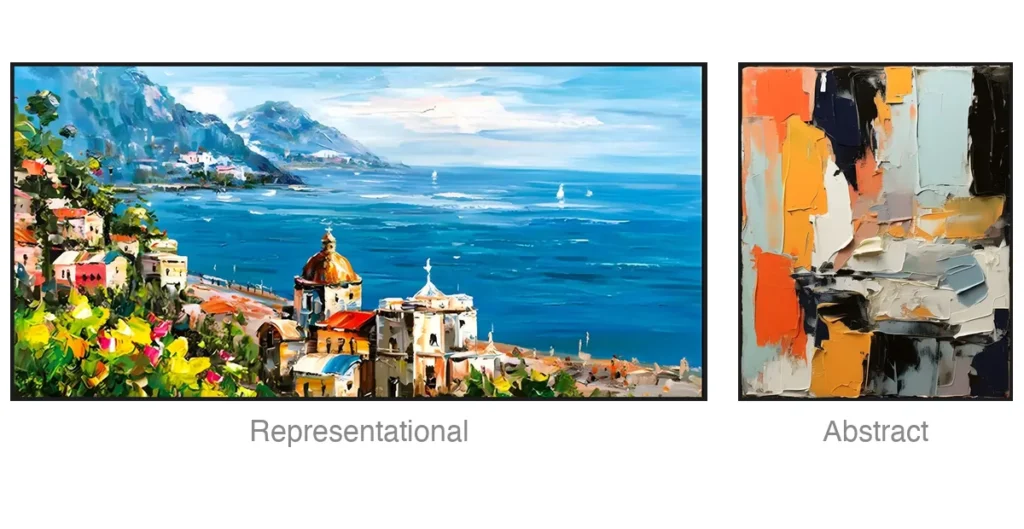
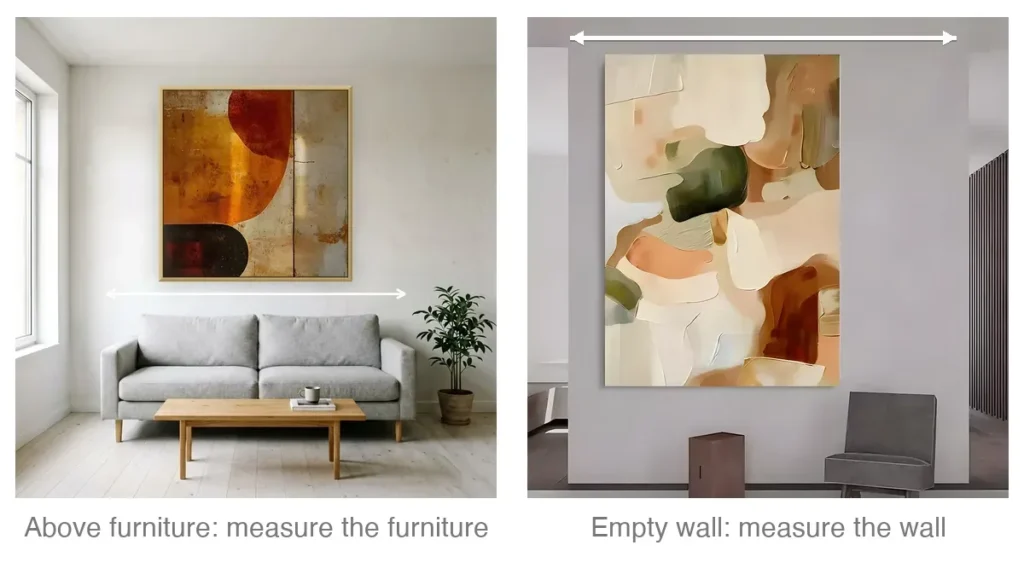
Find your eyes irresistibly drawn to a large wabi-sabi canvas hanging on the far wall, yet you just can’t name anything unique about it? It does not feature a perfectly symmetrical landscape or a crisply defined geometric grid. You only see thick, sweeping layers of plaster-like paint, a few visible brush marks that track the artist’s hand, and a surface that catches the light with coarse, gritty texture.
Strangely, you just feel an immediate, quiet pull to touch it. It feels grounded, calm, and utterly alive.
Why does such a cracked, uneven painting feel more calming than a perfectly complete and well-layered one? You are not alone in wondering what wabi-sabi art is.
It is a style rooted in Japanese aesthetics that finds beauty in things that are imperfect, impermanent, and incomplete. When you bring a wabi-sabi painting into your living space, you are making a conscious choice to slow down, breathe, and appreciate the raw, unpolished reality of existence. You can see real examples in our wabi-sabi collection as you read on.
Wabi-sabi meaning: what “wabi” and “sabi” mean on their own
Originally, the word wabi referred to the loneliness of living a solitary life away from society, out in nature. Over time it softened into a mindset of voluntary simplicity, rustic unpretentiousness, and quiet fulfillment. It is the joy of being content with very little.
It is the peace you feel in a bare room with one beautiful object in it, or holding a hand-thrown ceramic bowl that sits slightly off-kilter. The Stanford Encyclopedia of Philosophy describes wabi as a subdued, austere kind of beauty, the beauty of enough rather than more.
The word sabi is all about the passage of time. It speaks to the unique beauty that comes with age, wear, and natural deterioration. Think of the green patina on an old bronze statue, the soft weathering of a wooden barn door, or the fine network of cracks on an ancient oil painting. Where wabi is the humble soul of a thing, sabi is the visible footprint that age and use leave on it.
| Word | What it means | What you see in the art |
|---|---|---|
| Wabi | Humble, quiet simplicity | Bare space, muted color, one calm gesture |
| Sabi | The beauty of age and wear | Weathered texture, patina, a surface touched by time |
Put the two together and wabi-sabi becomes a quiet antidote to perfectionism: the humble, unpretentious soul of a thing, carrying the visible marks of time. The writer Richard Powell summed it up in one line, that wabi-sabi accepts “nothing lasts, nothing is finished, and nothing is perfect.” A wabi-sabi painting aims to look honest rather than flawless, like something a real hand made and time has been allowed to touch.
Wabi-sabi art principles: imperfection, impermanence, incompleteness
Wabi-sabi rests on three ideas, and each one leaves a mark you can point to on the canvas.
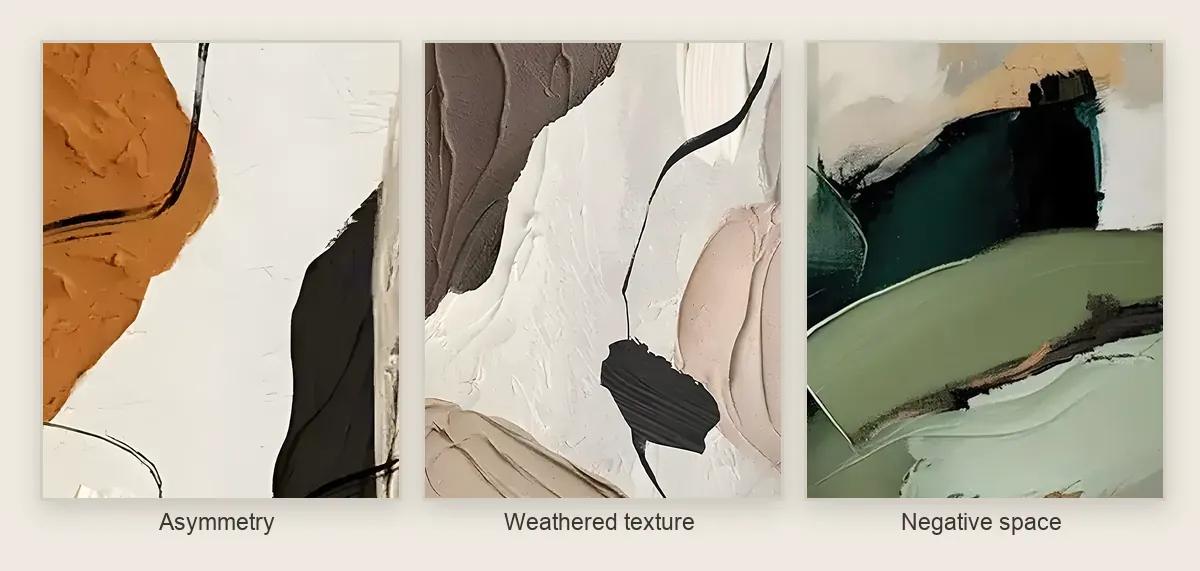
- Imperfection. Nothing is centered or evened out. A brushstroke wobbles. One side of the canvas gets more paint than the other. The Japanese call this off-balance look fukinsei, and instead of fixing it, the artist leaves it exactly as the hand made it.
- Impermanence. The surface looks like it has already lived a little: weathered, layered, softly worn. This is the mono no aware feeling, a gentle awareness that nothing stays, and that beauty and time are tied together.
- Incompleteness. Large areas are left open and empty, what Japanese aesthetics calls “ma,” the beauty of negative space. Often one edge or corner stays deliberately unresolved, so the piece breathes instead of filling every inch.
Once you can name those three moves, you stop reading captions to know whether something is wabi-sabi and start recognizing it on sight.
What does wabi-sabi art look like? The main types and styles
Words only get you partway here, because the whole point is how a surface behaves in real light. Still, the style tends to fall into a few loose families, and plenty of pieces live in more than one.
- Textured plaster abstract. Thick, built-up surfaces that look like aged wall or dried clay. The interest lives in the raised ridges and the small shadows they throw, not in any picture.
- Muted color-field. Soft blocks of low-saturation color that melt into each other, closer to a feeling than a scene. Calm, warm, and easy to live beside.
- Minimalist line or mark. One quiet gesture, a single line or smudge of pigment, surrounded by open space.
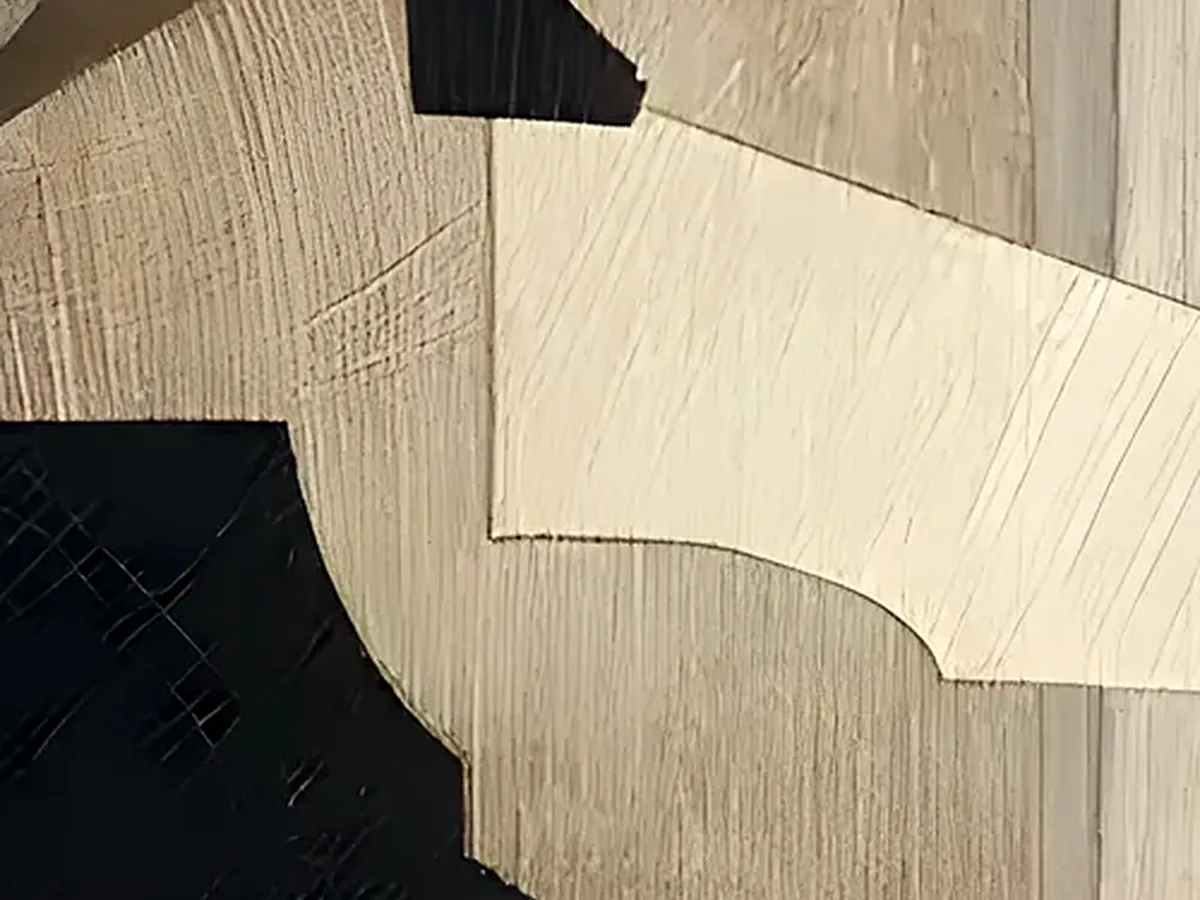
- Weathered and organic. Natural, imperfect shapes and edges that look worn by time, the way a river stone looks worn by water.
The balance is always asymmetrical. Instead of placing a shape dead center, the artist sets a heavy block of texture off to one side and lets a wide field of empty canvas answer it, the way a single boulder sits on a gravel beach. Don’t get too precious about the categories, either. A real painting might be a textured color-field with one organic mark, and that mixing is part of the charm.
How to tell if it’s wabi-sabi art?
Two things separate a real wabi-sabi piece from something that’s just borrowing the mood: the wabi-sabi color palette, and how the texture behaves in your hand and in your light.
Color
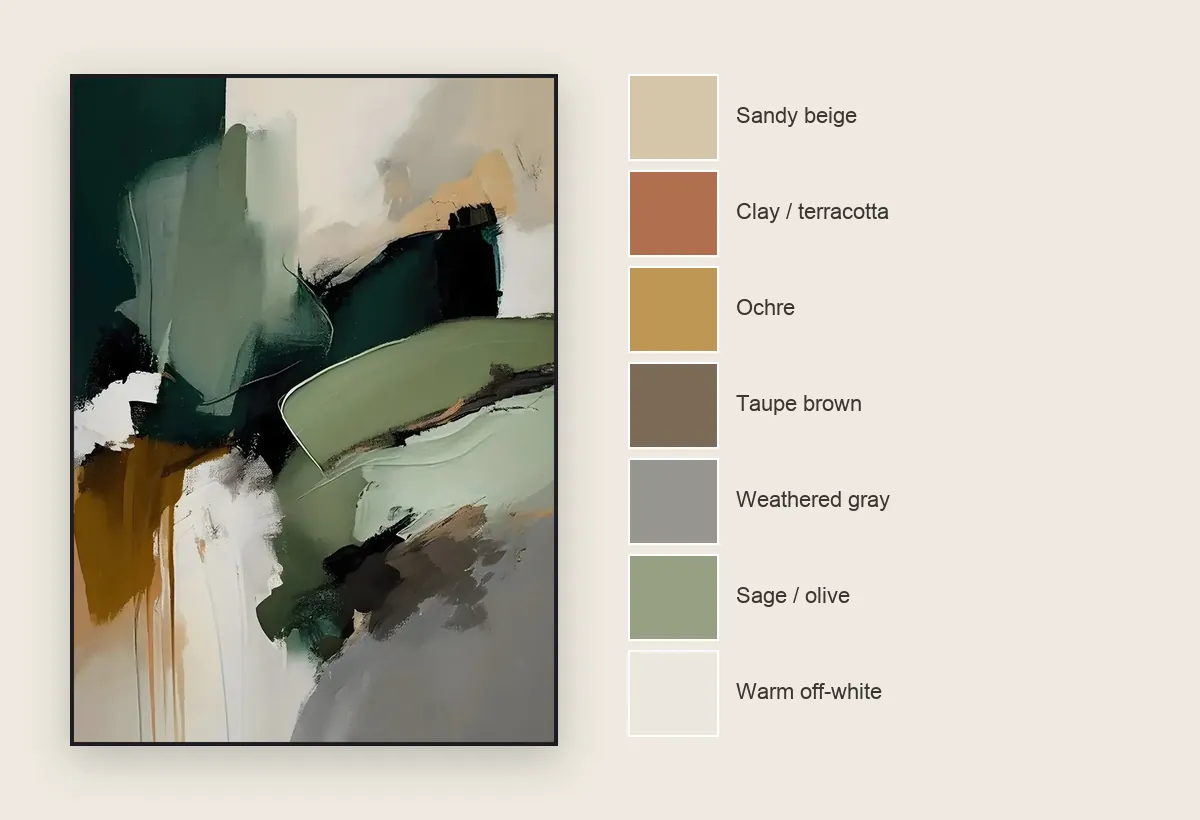
The wabi-sabi color palette is pulled straight from the earth, the sky, and the sea on a foggy morning: sandy beige and warm off-white as the base, taupe and muted brown, clay and terracotta for warmth, weathered gray and soft charcoal, and a touch of ochre or aged metallic for glow.
What ties them together is low saturation. These tones sit close to mineral pigments and earth, so they absorb light rather than bounce it back, which is why a wabi-sabi wall gives a room a soft matte hush instead of a bright pop.
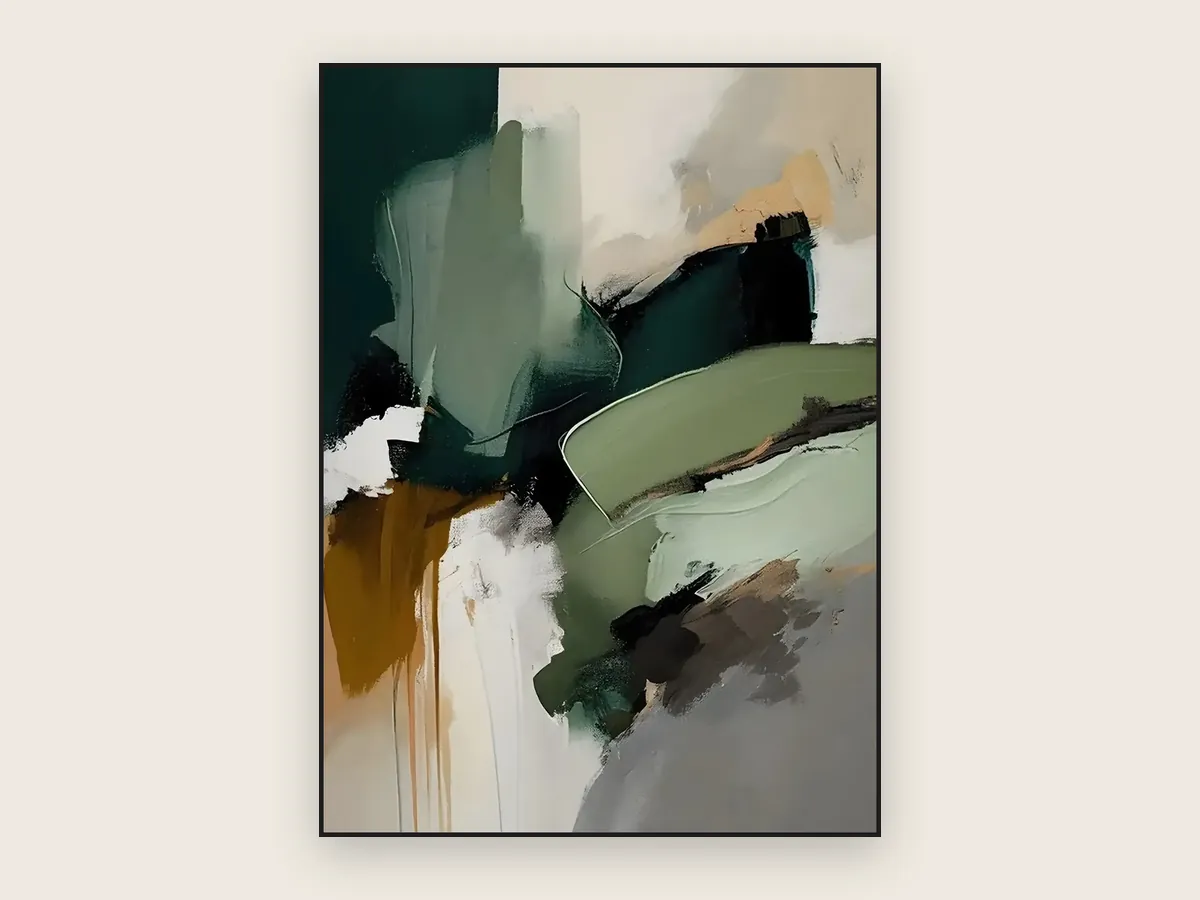
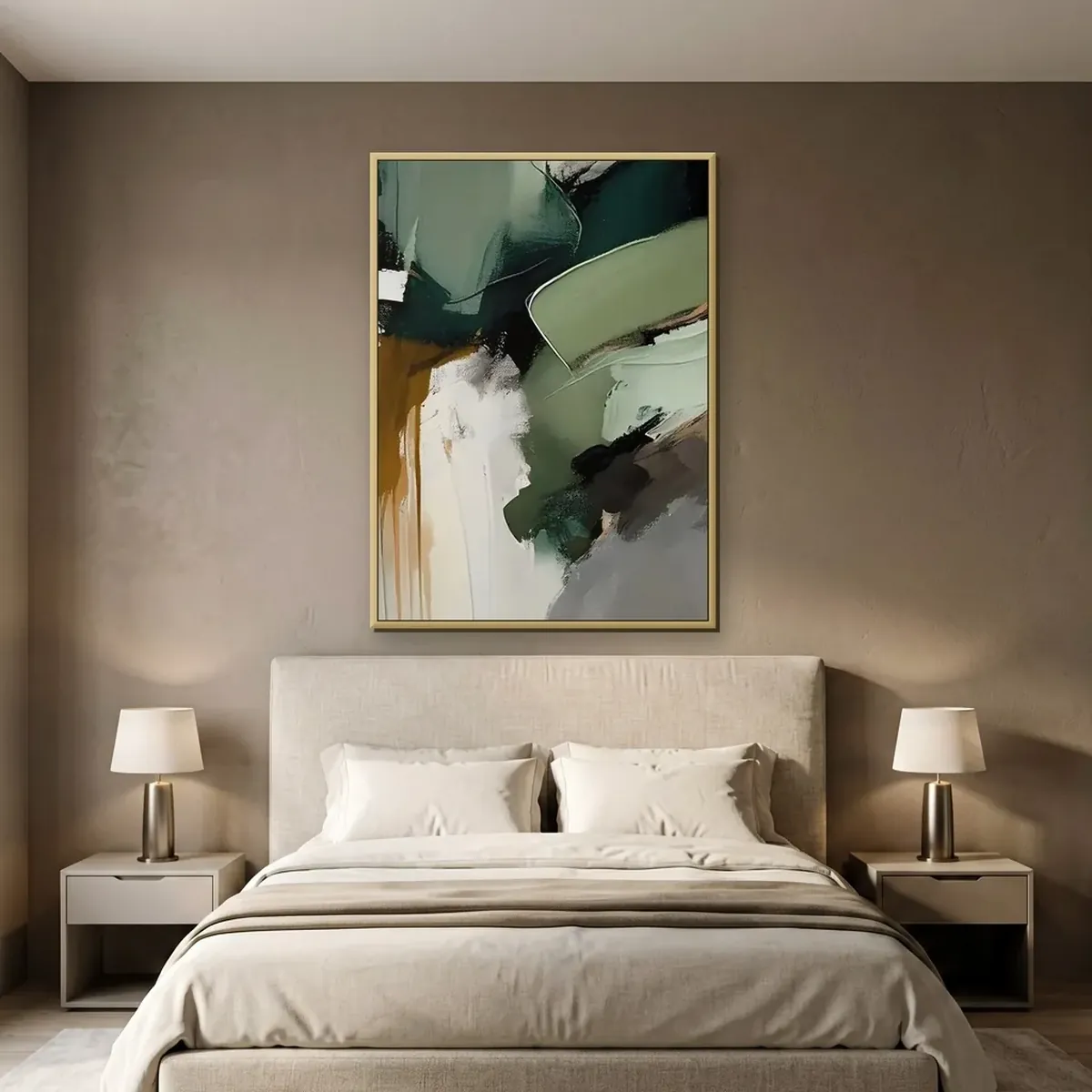
Our WA01, for instance, works in soft sage, deeper olive, cream, tan, and gray, and a palette like that is built to settle a room rather than compete with it, the reason so many wabi-sabi pieces live in our calming collection.
Texture and material
Because the color and composition stay so restrained, texture carries the rest of the feeling. Here’s what actually builds it:
| Material | What it does on the canvas |
|---|---|
| Plaster and modeling paste | Builds thick, sculptural ridges and small fissures that mimic old stone |
| Raw linen and cotton canvas | Lets natural fiber peek through thin layers of paint |
| Sand and mineral dust | Mixed into pigment for a gritty, stone-like grain that catches side light |
| Cold wax and thick impasto | Worked with a palette knife, then scraped back and layered again |
| Charcoal and graphite | Scores raw, sketchy lines into wet paint, recording the hand’s speed |
Working this way means sharing control with the materials. The plaster cracks where it wants to as it dries, and the paint pools heavier in some crevices than others. A wabi-sabi painter welcomes those accidents instead of sanding them away, because every ridge happens once, by hand, and never repeats.
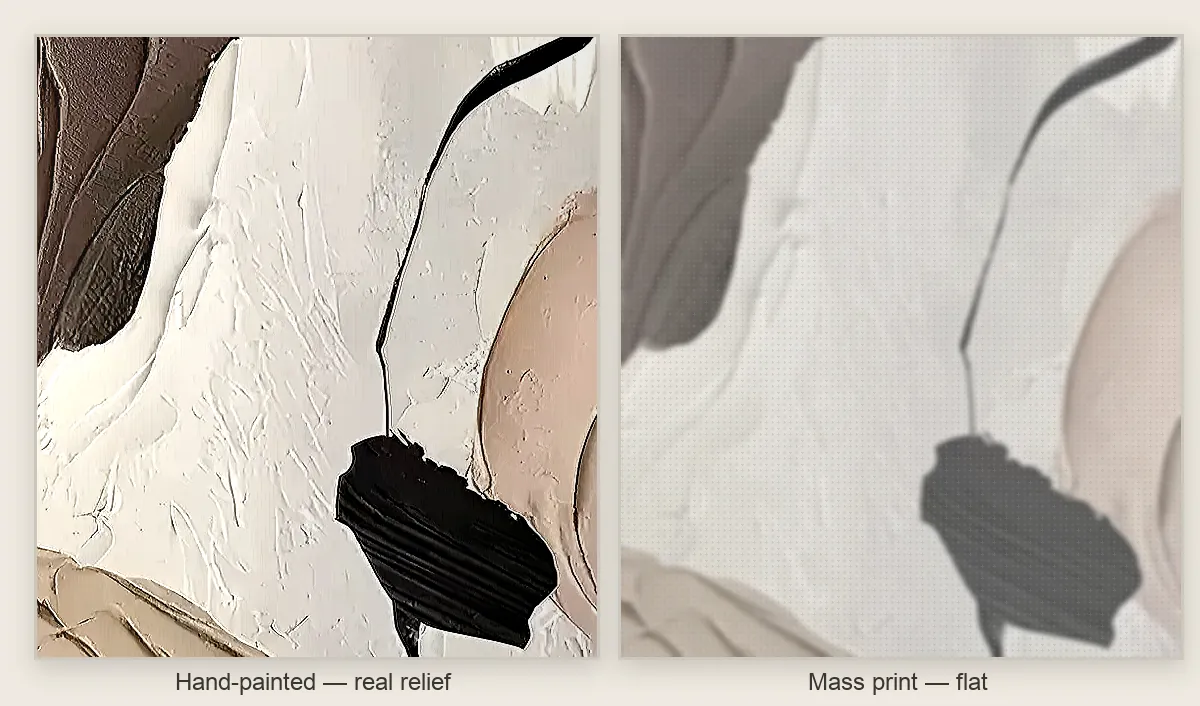
Which is exactly why a mass-produced print can’t really be wabi-sabi. A print reproduces one fixed, flawless surface a thousand times over, and wabi-sabi lives in the opposite of that: the one-of-a-kind irregularity of a handmade surface. So when you’re shopping and want to check whether a piece is the real thing, look for three tells:
- Real relief in raking light. Tilt the piece under a lamp. On a handmade surface, the ridges throw small shadows that shift as the angle changes. A flat print stays flat no matter how the light hits it.
- Texture that never repeats. On a genuine canvas, no two rough patches look the same. On a print, look closely and the “texture” often tiles, a faint pattern quietly repeating across the surface.
- Handmade shifts in tone. Color that varies a touch across the surface, thicker here and thinner there, is the fingerprint of a hand. A print’s color stays uniform and machine-even.
Learn those three tells and you can walk past a wall of lookalikes and know, at a glance, which ones a person actually painted. Every piece in our collection is a hand-painted original for exactly this reason.
Wabi-sabi origin and history
Wabi-sabi grew out of Japanese aesthetics and Zen Buddhism, especially the Buddhist idea that everything is impermanent. Its defining moment came in sixteenth-century Japan, when the ruling classes favored lavish, glittering art: the tea ceremony was performed with flawless polished porcelain imported from China, displayed in opulent golden rooms.
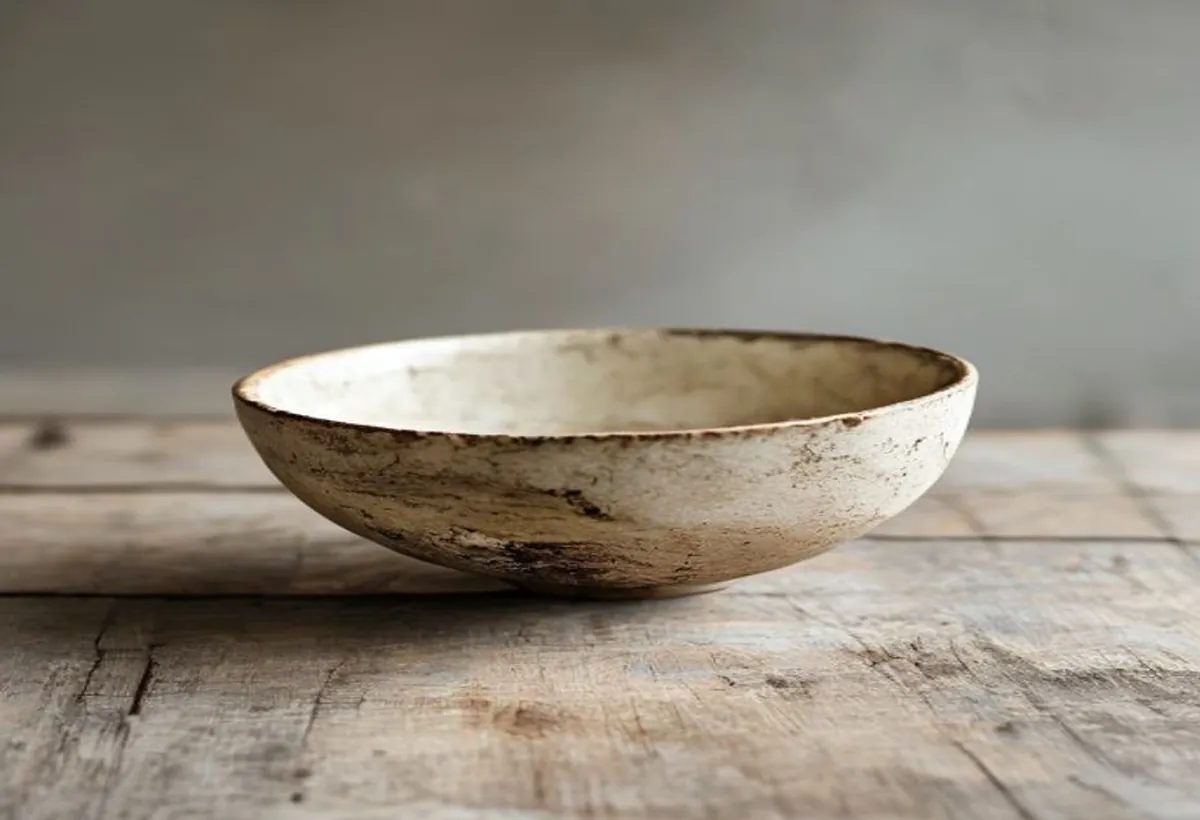
A tea master named Sen no Rikyū looked at all that shine and felt it missed the point. He moved the ceremony into small, rustic huts and began serving tea in local, hand-made Raku bowls that were uneven, heavy, and quietly imperfect.
That shift changed Japanese aesthetics for good: it taught people to find luxury in simplicity and the natural world instead of wealth and polish.
For centuries wabi-sabi stayed a lived tradition rather than a design trend. Then in 1994 the American author Leonard Koren wrote a small, influential book, Wabi-Sabi: for Artists, Designers, Poets & Philosophers, and carried the idea into Western design, defining it as “a beauty of things imperfect, impermanent, and incomplete.”
You may also have heard of kintsugi, the art of mending broken pottery with gold, and japandi, a decor style. Both are related to wabi-sabi but they are their own things, and we cover each in its own guide.
How to choose wabi-sabi wall art for home decor?
You don’t need a rustic concrete loft or a monk-level minimalist home to make this work. Because the art is so grounded and neutral, it settles into almost any interior, though its softness can get lost in a bright, high-gloss, high-contrast room. Here’s how it plays room by room.
Wabi-sabi art for the bedroom: calm before sleep
A bedroom wall works best low in contrast, since it is the last thing seen at night and the first thing seen in the morning. WA01, in soft sage, olive, cream, and tan, settles the room instead of pulling the eye at the moment someone is winding down. Look for a piece that reads as quiet rather than a piece that reads as a statement.
Wabi-sabi art for the living room: texture that catches the light
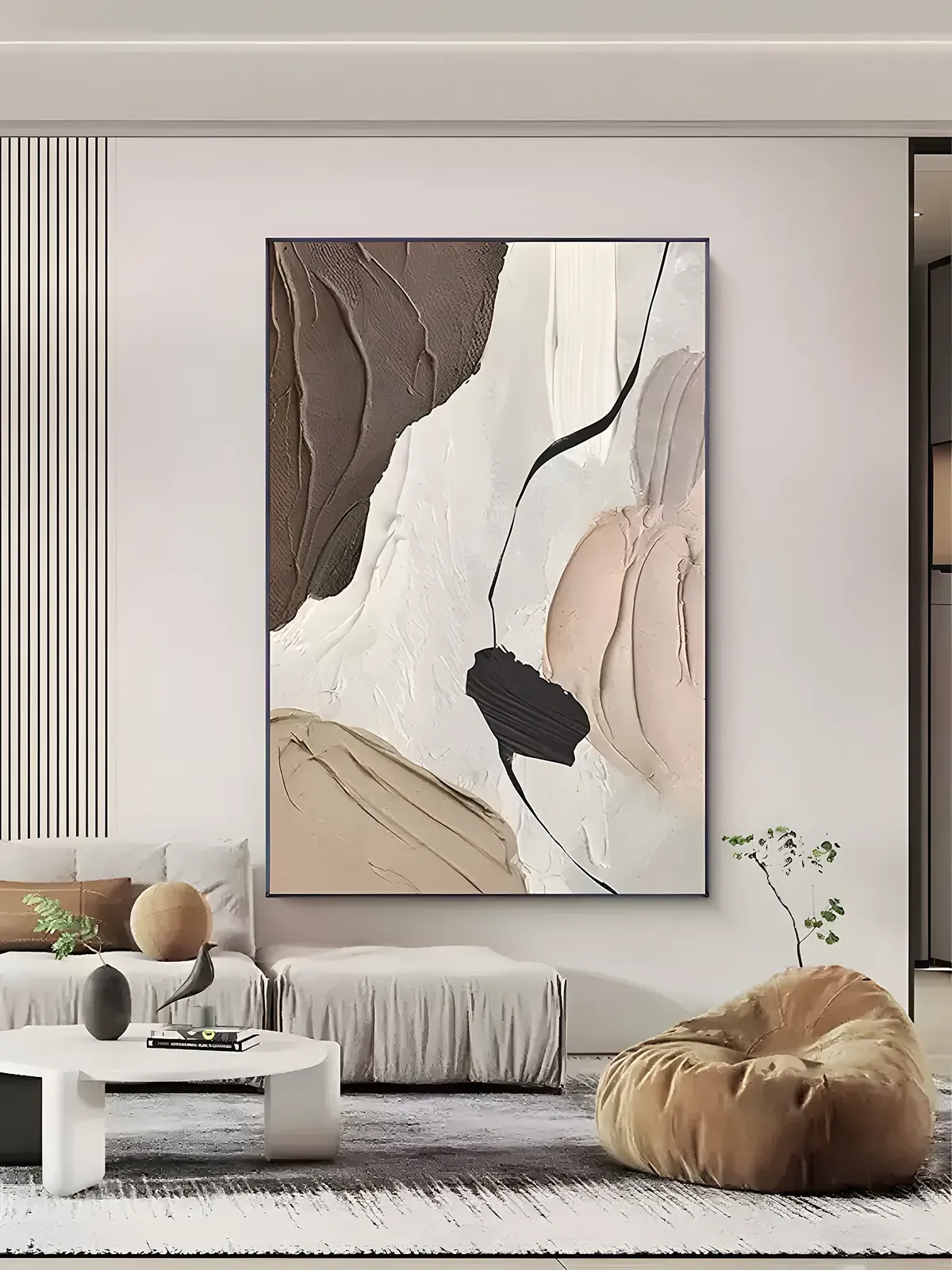
The living room is usually where daylight moves across a wall the most through the day, which makes it the best spot for the most heavily textured, plaster-built piece in the range. Hang it where the light rakes across it from the side, and the relief comes alive as the sun moves.
Wabi-sabi art for the hallway or entryway: a quiet welcome
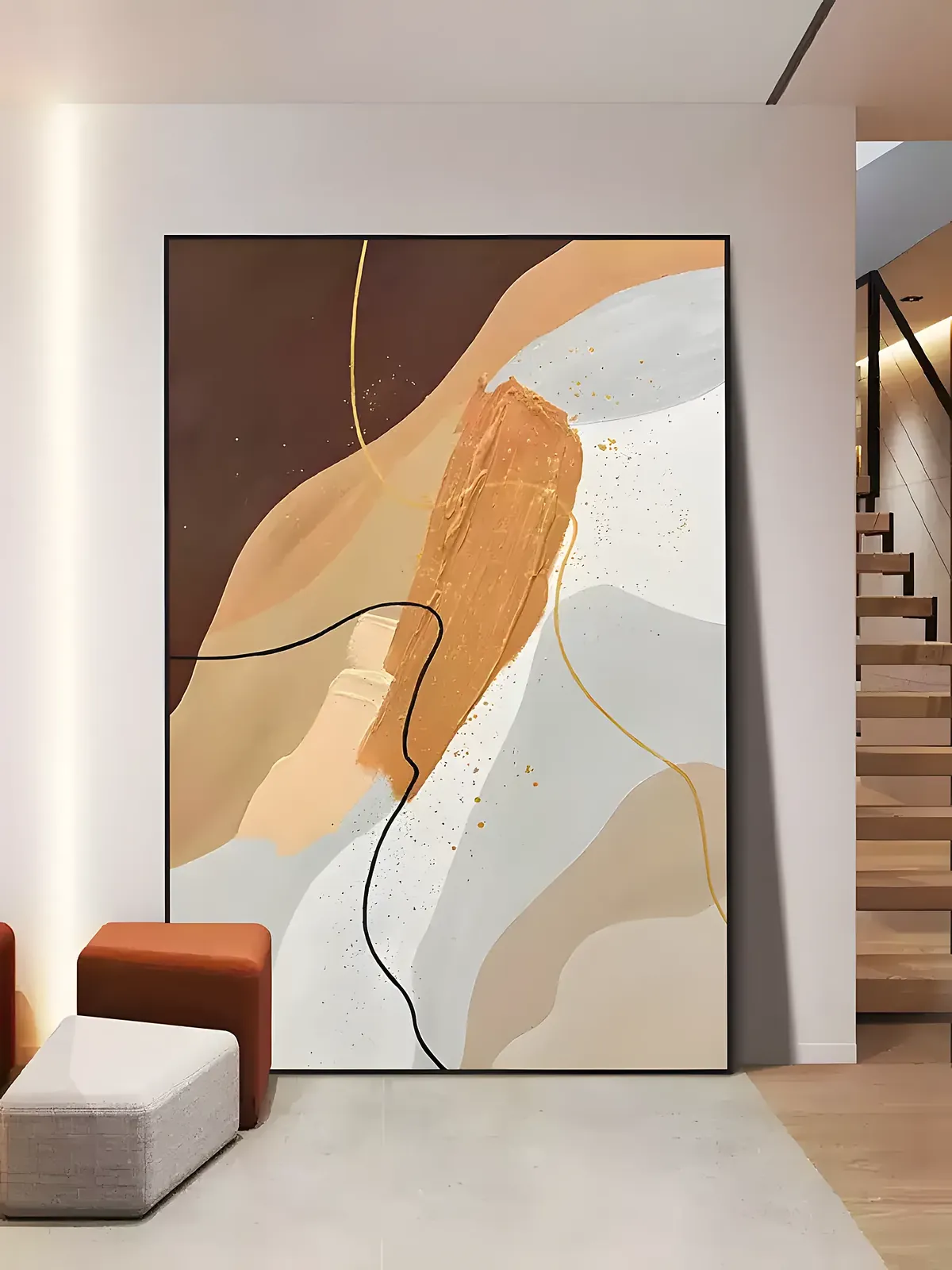
A hallway or entryway is often the narrowest, most overlooked wall in the house, and a minimalist wabi-sabi piece, a single mark and a lot of open space, fills it without crowding it. It’s a small, calm note the moment you walk in the door.
Wabi-sabi art for the bathroom: small and quiet
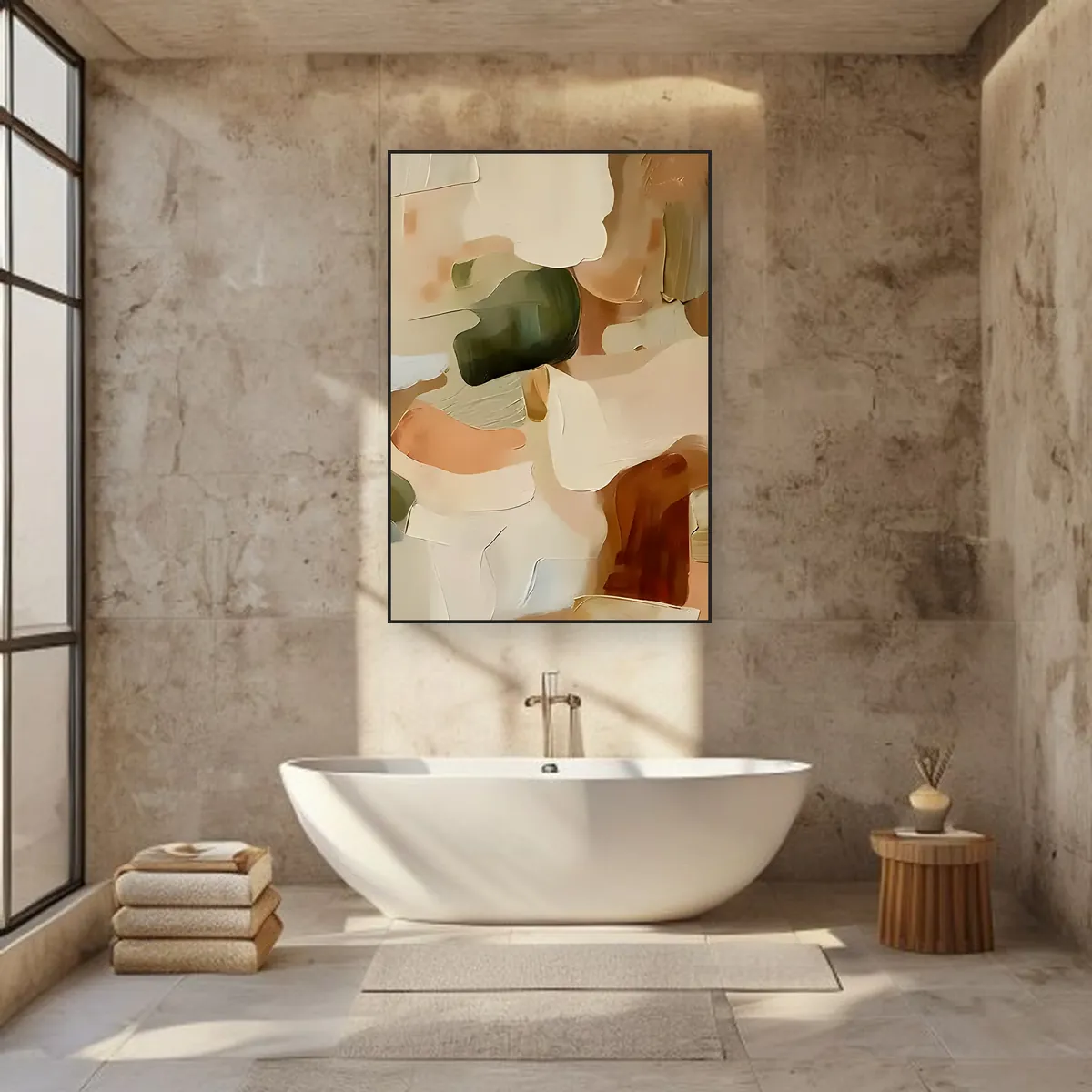
A bathroom is usually the smallest wall in the house, so a smaller wabi-sabi piece works better than an oversized one. A minimalist or muted color-field piece keeps the space feeling calm rather than crowded.
One buying tip across all of these: look at the lightness of the wall color first, then choose a piece that harmonizes with it rather than chasing high contrast, which fights the whole calm intention.
Frequently asked questions
Is wabi-sabi only Japanese?
It began in Japan, born from Zen Buddhism and the tea ceremony. But as a way of seeing beauty in imperfect, natural, quiet things, it travels anywhere. You can bring wabi-sabi into any home, in any country, and it won’t feel out of place.
Does wabi-sabi mean ugly or unfinished?
No. Wabi-sabi is deliberate, thoughtful imperfection, not carelessness or damage. The asymmetry and open space are chosen on purpose to feel calm and honest. It reads as intentional and refined, which is the opposite of sloppy or broken.
What is the difference between wabi-sabi and minimalism?
Minimalism often chases sleek perfection: hidden seams, flawless surfaces, sharp lines. Wabi-sabi shares the love of simplicity and empty space but welcomes warmth, texture, age, and organic flaws. Think of it as minimalism with a heartbeat.
How is wabi-sabi different from japandi?
Japandi is wabi-sabi’s calm meeting Scandinavian design, blending Japanese quiet with Nordic clean lines and light woods. Wabi-sabi is the older aesthetic idea underneath it. We cover japandi more fully in its own guide.
How is kintsugi related to wabi-sabi?
Kintsugi, repairing broken pottery with gold so the cracks show, is the most famous concrete expression of wabi-sabi. It celebrates the flaw instead of hiding it. It is one beautiful example of the idea, not the whole aesthetic.
What is mono no aware and how does it relate to wabi-sabi?
Mono no aware is a tender awareness that nothing lasts, a soft sadness at the passing of things. It sits right next to sabi, the beauty of age and time, and it is part of why weathered surfaces move us in wabi-sabi art.
Is wabi-sabi a real word or a real thing?
Yes. It is a genuine term from Japanese aesthetics, centuries old, not a word invented for social media. Wabi and sabi both come from long traditions in Japanese art, tea, and Zen thought.
How do you make wabi-sabi art yourself?
At a high level, you build real texture with plaster or modeling paste, keep the palette muted and earthy, and leave plenty of open space. The goal is an honest, handmade surface rather than a polished one. It’s a whole craft, worth its own guide.
Where can I buy authentic wabi-sabi art, not a mass-printed lookalike?
Look for hand-painted originals with real, non-repeating texture, the tells covered above. Every piece we make is painted by hand, one canvas at a time, and can be made to your size and colors.
Living with wabi-sabi art
Wabi-sabi art reaches you precisely because it doesn’t pretend to be perfect. Understanding it takes no Japanese vocabulary, just the permission to be moved by calm, by empty space, and by the honest marks a hand leaves behind.
And the real thing only holds when that imperfection genuinely lives on the surface, made once, by a person, never quite repeated. If a certain bare wall has been waiting for a piece that finally lets you slow down, start with our hand-painted wabi-sabi originals, and if none is the exact size or color you need, we’ll paint one that is.