Order a hand-painted reproduction of Vincent van Gogh’s The Starry Night on premium linen, in acrylic or oil, at the original size or a custom size for your wall. One painter takes each canvas from the first drawing to the last brushstroke. Nothing is printed. We send progress photographs at roughly 30 percent, 50 percent, and 100 percent completion, then ship only after you approve the finished painting.
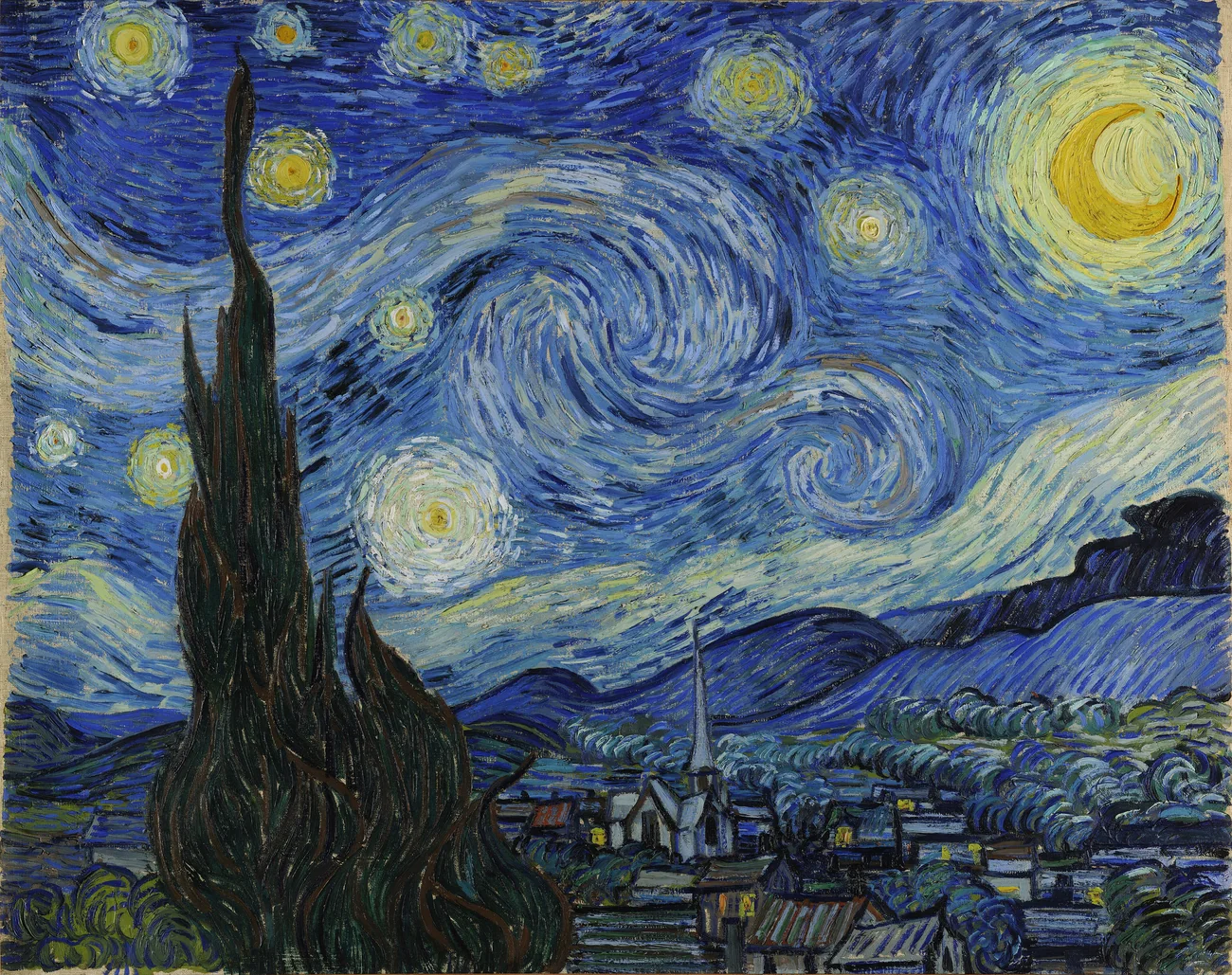
The Starry Night by Vincent van Gogh: history, meaning, and legacy
Vincent van Gogh painted The Starry Night in Saint-Remy, France, in June 1889. It is an oil painting, 73.7 by 92.1 cm, or 29 by 36.25 inches. The original is held by the Museum of Modern Art in New York, whose collection record is the reference for the date, medium, dimensions, and history used on this page.
| Artist | Vincent van Gogh, 1853 to 1890 |
|---|---|
| Painting | The Starry Night, June 1889 |
| Original medium | Oil on canvas |
| Original size | 73.7 by 92.1 cm, or 29 by 36.25 inches |
| Collection | The Museum of Modern Art, New York |
| Our version | Hand painted on premium linen, in acrylic or oil, at any size |
The view behind the painting
The painting began with the view from van Gogh’s window at Saint-Paul-de-Mausole, where he was living in 1889. It was not painted outside at night. He made it in several daytime sessions, using the remembered view as a starting point. The hills, village, cypress, and sky do not simply report what stood before him. The village could not be seen from the window, and the cypress was brought much closer. Observation, memory, and imagination all meet in the finished picture.
Why it still feels immediate
The sky moves in large blue turns, while the village sits low and quiet. The cypress rises like a dark flame between them. This gives the painting a clear structure from across a room, then far more to see when you move closer. The stars and moon are small areas of warm light against a large field of blue, so the picture feels bright without becoming loud.
That balance is one reason The Starry Night is reproduced so often. It has a recognizable silhouette, strong color, and real surface texture. A good hand-painted version does more than repeat the image. It brings back the raised paint, directional strokes, and changing light that make the original feel physical rather than flat.
The Starry Night as a Post-Impressionist painting
The Starry Night is a Post-Impressionist painting, not an Impressionist one. Impressionist painters often used visible marks to record shifting light in the world around them. Van Gogh pushed color and brushwork further. In this painting, the sky does not just describe a June night. The deep blues, warm yellow halos, and repeated curves turn the painted surface into part of the subject.
That is why the work became important to later ideas of modern painting. It shows that a landscape can be rooted in a real place while still carrying mood, memory, and feeling. The Museum of Modern Art describes the painting as both an exercise in observation and a clear departure from it. For a reproduction, that distinction matters. Copying the outlines is not enough. The relationship between line, color, and texture has to survive.
The Starry Night composition, colors, and brushwork
Composition
The painting has three main parts: the large sky, the hills and village below it, and the cypress at left. The sky takes most of the canvas. The village stays low, made from small, still rectangles and a narrow church spire. The cypress begins at the lower edge and reaches almost to the top. It connects the quiet land to the moving sky.
The arrangement is carefully controlled. The dark cypress and pale church spire are the two vertical notes. Between them, the hills move across the horizon while the large swirl sits in the middle of the sky. The village does not join the movement. Its stillness makes the sky feel even more active.
Colors and light
The painting is built around several close blues, from dark indigo at the edges to lighter blue and blue-green near the moon. The warm notes are smaller and more controlled. The stars and moon are closer to olive gold and pale cream than bright lemon yellow. Their halos are what make them read as sources of light instead of yellow shapes placed on a blue background.
Those halos are not soft airbrushed fades. They are distinct passages of paint that step from warm yellow through pale green into blue. The moon uses the same idea on a larger scale. A good reproduction has to keep the sky deep enough for those small warm passages to matter.
Brushwork and surface
Van Gogh used short marks in different directions. The sky curves and turns. The hills travel across the width of the canvas. The cypress rises vertically. The village uses smaller and quieter strokes. Heavy paint sits in the sky, moon, and stars, while other areas are thinner. This variation is why the surface feels alive under raking light.
Why a hand-painted Starry Night reproduction is difficult to paint well
The subject is famous, but it is not easy. Most weak copies get the symbols right and the relationships wrong. These are the points that make the difference.
- The sky needs one continuous rhythm. The large swirls cannot become separate decorative loops. They must turn through the sky while the upper and lower bands stay calmer.
- The yellow must stay controlled. Too much bright lemon yellow turns the painting into a poster. The original uses warm, restrained light against a much larger blue field.
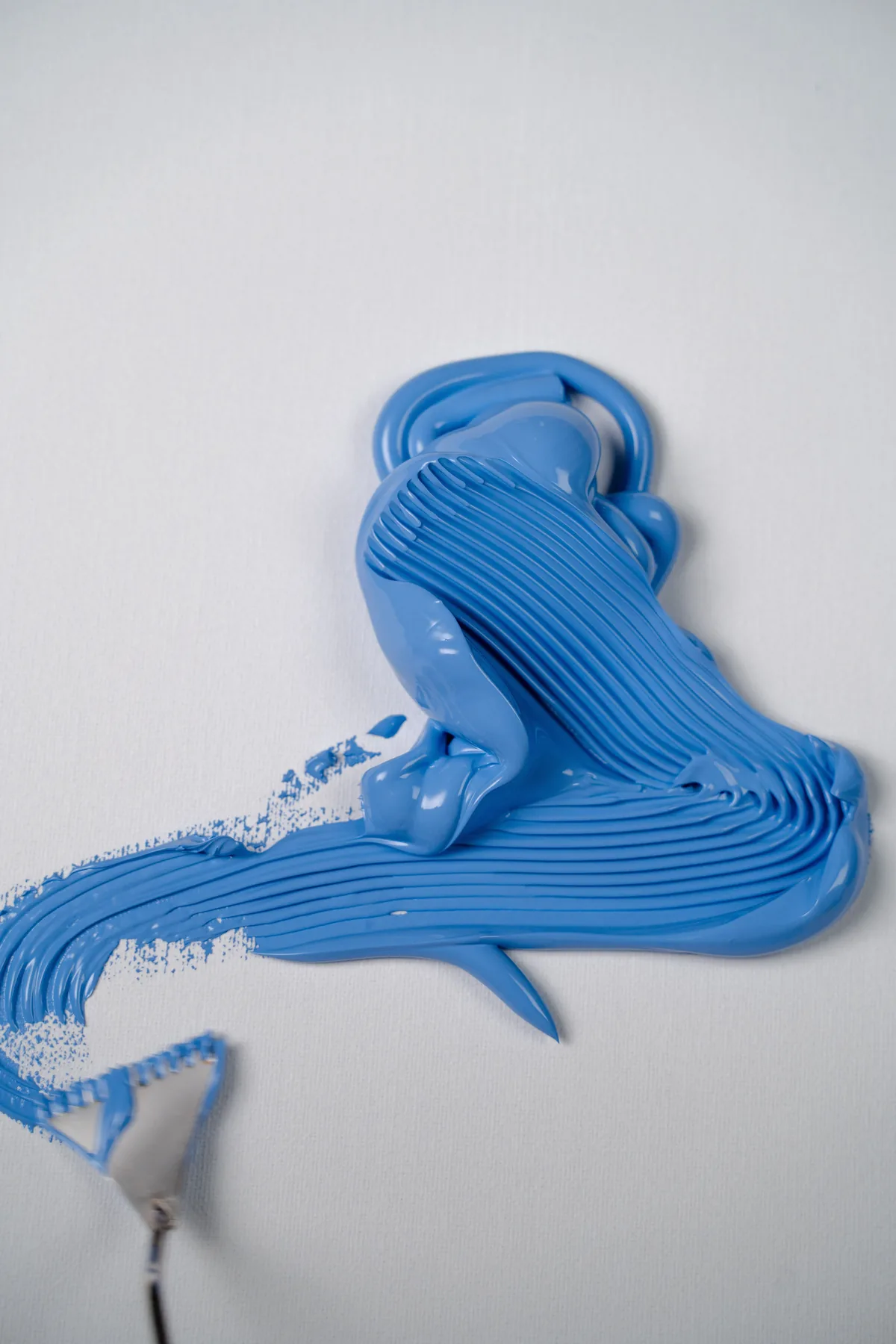
- The texture cannot be uniform. The stars, moon, and ridges of sky need thicker paint. The cypress and village need less. One paint thickness everywhere makes the picture feel flat.
- Each part needs a different stroke direction. The tree rises, the land travels sideways, and the sky curves. Repeating one wrist movement across the whole canvas removes the painting’s structure.
- The proportion matters at every size. The original is a 5 by 4 landscape. When the canvas grows, the brushwork must grow with it. Small marks on a large canvas look busy rather than convincing.
How we paint a Starry Night reproduction
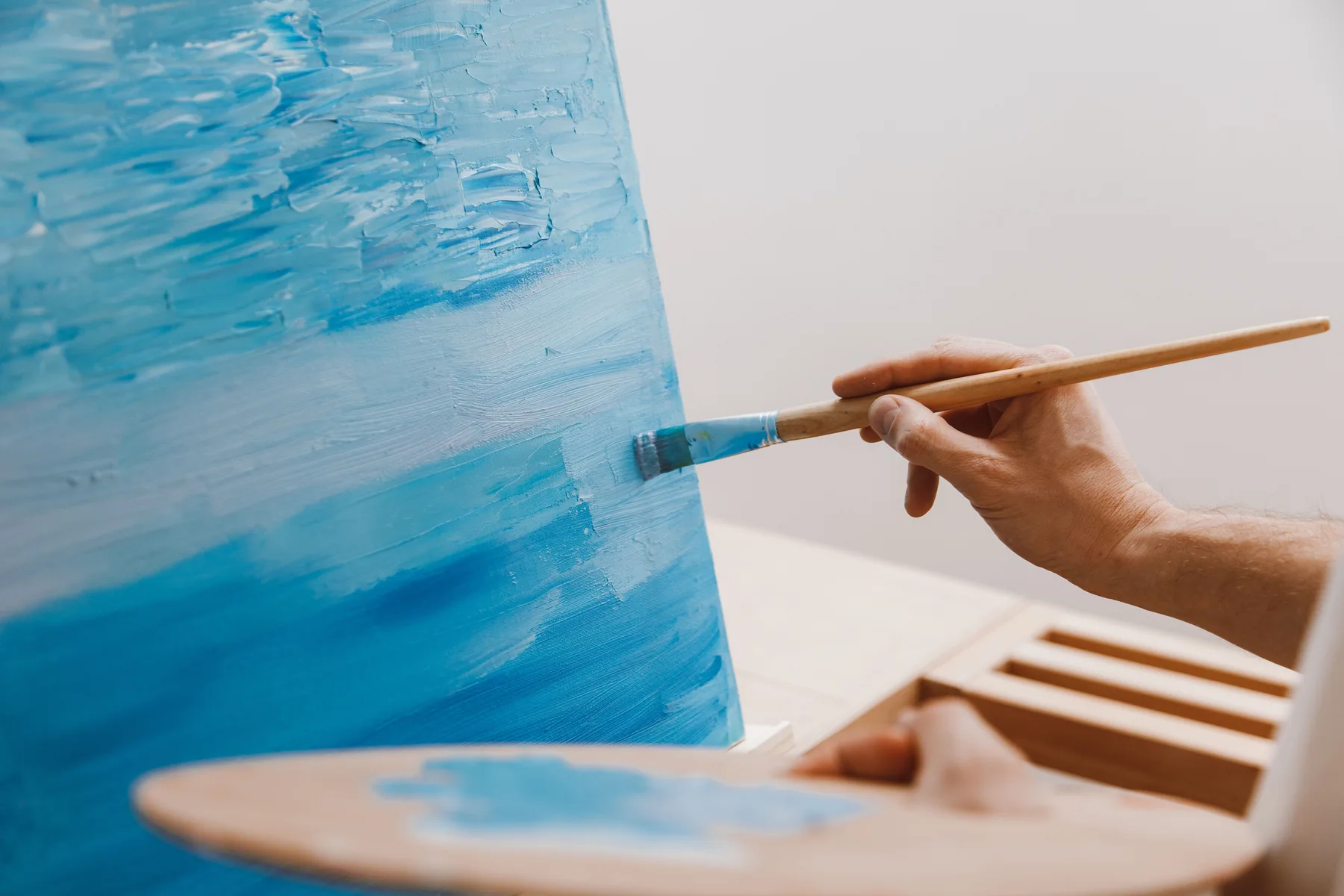
One painter is responsible for the complete canvas. The work is not divided between separate hands, which helps keep the brush rhythm and color decisions consistent from beginning to end.
- Drawing and placementWe set the horizon, village, cypress, church spire, moon, and major sky movement before real texture begins. At roughly 30 percent completion, you receive a progress photograph showing the composition and the first color fields.
- Sky and color relationshipsWe mix the blue, blue-green, cream, and warm yellow families against the reference on the palette. The sky is built in directional passages, while the village remains quieter. At roughly 50 percent, you see how the sky, cypress, moon, and village are working together.
- Impasto and lightThe ridges of sky, the moon, and the stars are finished with the heaviest paint. Their warm halos sit over the cooler blue instead of blending into it.
- Finished-canvas approvalAt 100 percent completion, we send photographs of your finished painting. You can see the actual color, brushwork, and texture before shipping. Nothing leaves the studio until you approve.
For a larger project, we can begin with a sample piece. The remaining canvases follow after the sample is approved, so size, color, and finish are settled before a full run begins.
How to tell a hand-painted Starry Night from a canvas print
Some printed canvases have clear gel brushed across their surface to imitate texture. A listing image alone cannot always show the difference. These four checks are useful for any painting you buy.
- Look across the surface in raking light. Real paint makes ridges and shadows that follow the image. In The Starry Night, the thickest passages should sit in the sky, stars, and moon.
- Look closely at a calm blue area. A print resolves into an ink pattern. Paint resolves into individual marks, color changes, and the weave of the linen where thinner paint was used.
- Check whether the texture has a reason. Meaningful texture changes with the picture. A uniform gel surface often looks equally raised in the village, sky, and background.
- Check the painted edges on a stretched canvas. Brush-applied color moves naturally over an edge. A printed image normally ends in a cleaner mechanical line.
PaletteMomento paints every reproduction by hand on premium linen. We do not print an image, and we do not add texture over a print.
Starry Night reproduction sizes, oil or acrylic, and framing
Choosing the size
The original is 29 by 36.25 inches. That size suits a study, reading room, gallery wall, or a smaller space where matching the original matters. On a wider wall, keeping the original 5 by 4 proportion usually works better than forcing the image into a standard shape. A 48 by 38 inch or 60 by 48 inch canvas keeps the same relationship between sky, cypress, and village.
For art above a sofa, bed, or console, begin at about two thirds of the furniture width. Send us the wall width, room type, and finish you have in mind. We will help you settle the dimensions before painting begins. We offer 60 standard sizes from 24 by 20 to 80 by 60 inches, as well as custom measurements. Larger single canvases are quoted separately.
Acrylic
Acrylic is our standard material. It holds raised brushwork well, so it is a strong choice when the physical movement of the sky matters most.
Oil
Oil is available on request for buyers who want the original medium. It takes longer to complete, especially on a painting with heavy impasto.
Stretched canvas
Stretched canvas protects the raised surface and is ready to hang. It suits most individual Starry Night orders.
Framed or rolled
A black, white, wood, silver, or gold frame gives a finished gallery look. Rolled canvas can suit larger project orders, although it needs careful restretching at its destination.
Starry Night reproductions for trade and commercial projects
Trade buyers do not all need the same thing. A designer may need a custom size that fits a client wall. A hotel may need matching canvases across a guest-room group. A restaurant, office, retail space, club, model home, or staged property may need a consistent finish across several different subjects. We plan the work around the space, quantity, installation date, and finish rather than treating every order as a single retail purchase.
Interior designers, decorators, and art consultants
We can work from a wall measurement, a reference image, and a material board. The original proportion can be kept, or the image can be adapted carefully for a specific location. For a group of paintings, matching frame color, canvas depth, and visual weight matters as much as the individual picture.
Hotels, restaurants, and hospitality spaces
The Starry Night can work in guest rooms, lounges, libraries, restaurants, and corridors because the large blue field reads calmly from a distance while the raised surface rewards a closer look. It can stand alone as a focal piece or be paired with related van Gogh works such as Sunflowers, Almond Blossom, and Cafe Terrace at Night.
Quantities, samples, and timing
There is no minimum order. Trade rates improve at 6 pieces and again at 21, with mixed designs counted together. Production is usually 7 to 10 business days for 1 to 5 pieces, 10 to 15 business days for 6 to 20 pieces, and 15 to 20 business days for 21 to 50 pieces. For a first order or larger project, a sample can be painted first, with the sample cost credited back on an order of 10 pieces or more.
For a trade quote, send the painting, size, quantity, finish, destination, and installation date. WhatsApp replies are usually immediate; email replies usually arrive within 12 hours. More project information is available on our trade page.
Is The Starry Night in the public domain?
Yes. Vincent van Gogh died in 1890, and The Starry Night is in the public domain. It can be painted and sold as a reproduction in the United States and the European Union. A public-domain painting may be copied, but a copy must never be presented as the original.
Every PaletteMomento version is unsigned and described as a hand-painted reproduction. We do not copy van Gogh’s signature, age the surface to imitate an old canvas, or describe a new painting as an original. That clarity matters for private buyers and commercial projects alike.
Starry Night reproduction FAQs
Is this the same painting as Starry Night Over the Rhone?
Is this a hand-painted Starry Night reproduction or a canvas print?
What size is the original Starry Night?
Will I see the painting while it is being made?
Should I choose oil or acrylic for a Starry Night reproduction?
Can you paint The Starry Night larger than the original?
Should a Starry Night reproduction be stretched, framed, or rolled?
Is it legal to order a Starry Night reproduction?
Tell us the size, quantity, finish, and destination. There is no minimum order.