Order a hand-painted reproduction of Vincent van Gogh’s Sunflowers on premium linen, in acrylic or oil, at the original portrait proportion or a custom size for your wall. The default reference here is the 1888 painting of fifteen flowers in the National Gallery collection, London. Van Gogh made several Sunflowers, so send a museum link or image if you mean another version. One painter takes each canvas from drawing through the last textured passages. Nothing is printed. We share photos and short videos as the painting goes, then send daylight photographs of the finished canvas for your approval before it ships.
Van Gogh’s Sunflowers: which version are you looking for?
“Sunflowers” is not the name of one fixed painting. Van Gogh made seven still lifes of sunflowers in Provence in 1888 and 1889. Some have a yellow background, others a blue one; the number and condition of the flowers change; their proportions are not interchangeable. A reproduction page should state which work it begins with instead of letting a generic title hide the decision.
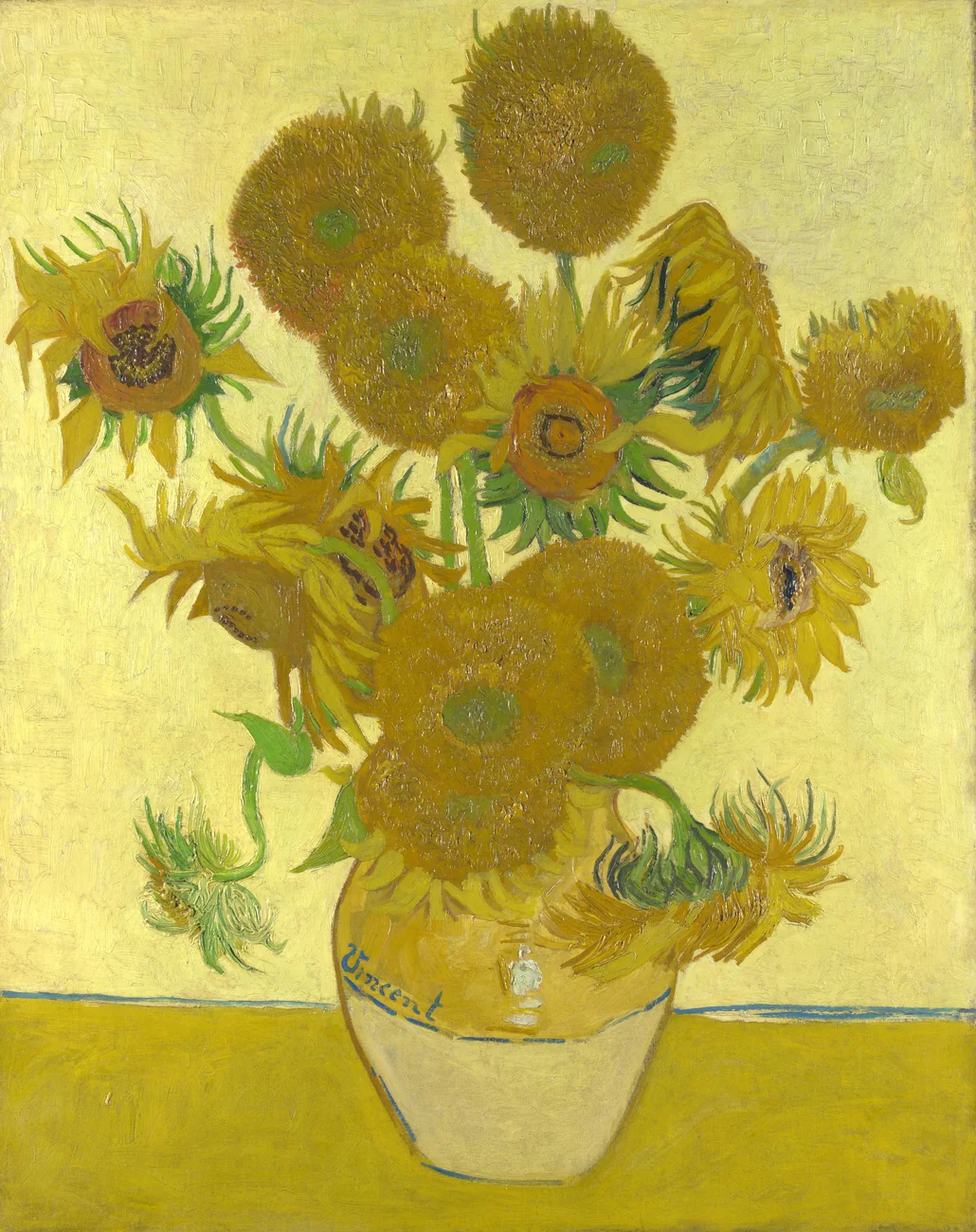
The default on this page is the 1888 National Gallery work, catalogue number NG3863. It is oil on canvas, 92.1 by 73 cm, or about 36.3 by 28.7 inches, and it shows fifteen flowers in a vase. The blooms move from a new bud through full flower to seed heads losing their petals. That life cycle gives the image more weight than a simple bouquet, even before you notice the brushwork.
This painting was made while Van Gogh was preparing the Yellow House in Arles for Paul Gauguin’s arrival. The National Gallery explains that the London work and a Munich version were intended for Gauguin’s room, as a welcome to the artist with whom Van Gogh hoped to work. It turns the familiar picture into something more human: a painting about friendship, expectation, colour, and an imagined creative community.
If another Sunflowers version is the one you mean, send the museum link, screenshot, or object number before requesting a quote. We can review a specific public-domain source and its proportion before painting. The National Gallery collection record is the source for the default-work facts here. It does not imply a museum affiliation, and every PaletteMomento canvas is an unsigned hand-painted reproduction.
Post-Impressionist Sunflowers: yellow on yellow, not a simple floral still life
Van Gogh’s Sunflowers belongs to the intensity of Post-Impressionism rather than a polite still-life tradition. The National Gallery describes the painting as a bold yellow-on-yellow experiment. Flowers, vase, table, and wall all sit in related yellows, yet the image seems to radiate light. That is a risky design: a less exact version would let the vase disappear into the wall or turn every petal into the same orange-brown note.
The palette is not simply “one yellow.” National Gallery research identifies several varieties of chrome yellow in the London and Amsterdam paintings. In the London work, the pale wheat-yellow wall is built with criss-crossing brushwork, the table is a denser mustard-yellow band, and a thin blue line separates them. The vase, flowers, and seed heads change the relationship again. Yellow becomes structure, not decoration.
Van Gogh was not trying to make the flowers look botanically exact. The petals, leaves, and stems are handled with directional marks; the seed heads have denser, more tactile paint. The subject carries happiness, friendship, bloom, decline, and the pressure of a very short-lived cut flower. That combination is why the work remains so recognisable without becoming visually simple.
Why a hand-painted Van Gogh Sunflowers reproduction is difficult to paint well
This is one of the clearest examples of why “visible brushstrokes” are not enough. The original’s energy comes from distinct relationships, not from applying a uniform layer of texture.
- Yellow has to separate into many values. Petals, the vase, table, wall, and shadow all work within related yellows. If the value steps collapse, the painting becomes a single flat field.
- Each flower has a different state of life. Buds, upright blooms, drooping flowers, missing petals, and seed heads create the rhythm of the bouquet. Repeating one neat flower shape misses the point.
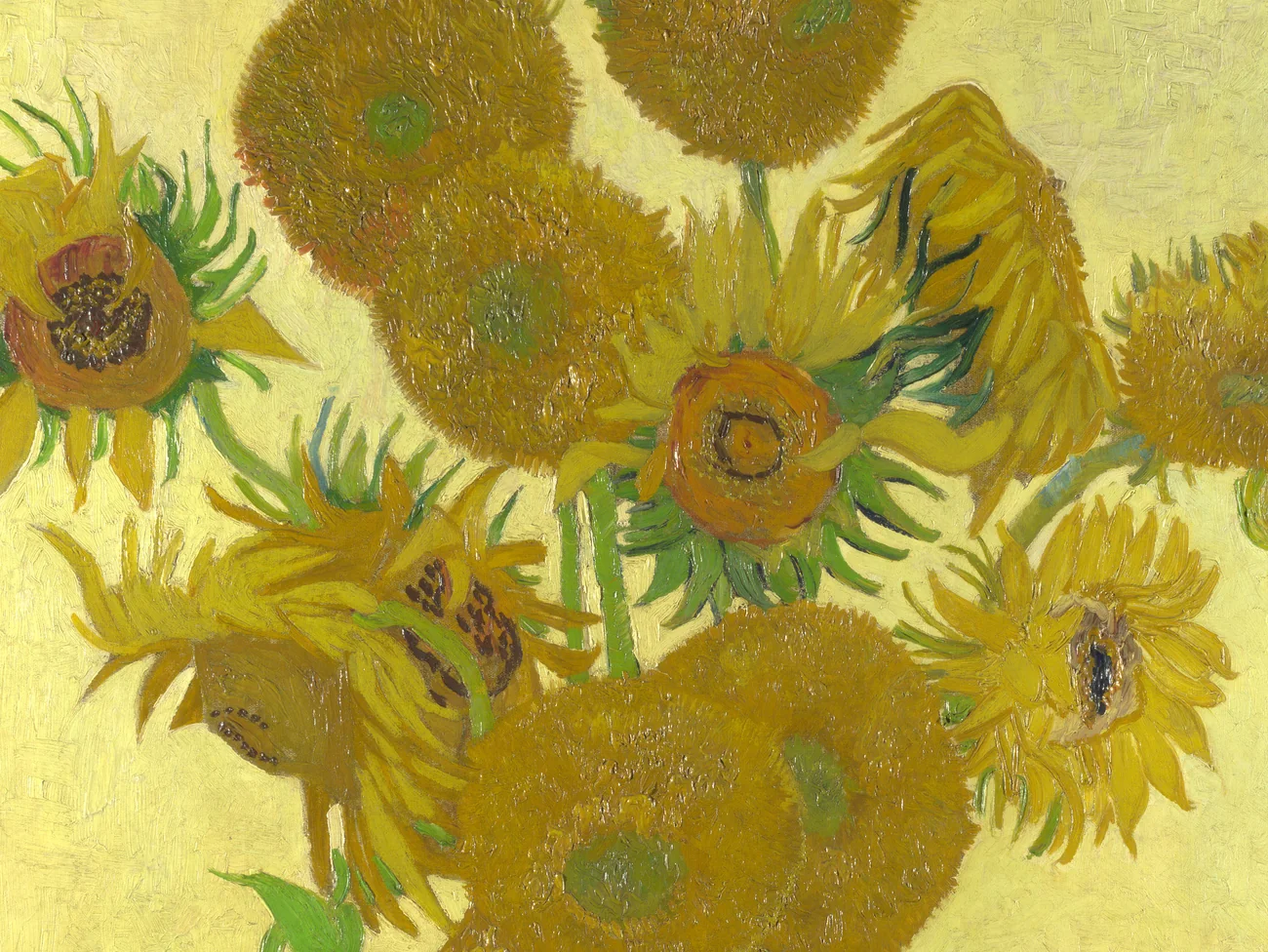
- Brushwork must follow form. Long marks move along petals, leaves, and stems; denser dabs belong in the seed heads; the wall has a different movement again. Surface variation needs a reason.
- The blue accents must remain measured. A thin cool separation makes the yellows more legible. Too much blue changes the painting’s balance; too little allows the vase and table to merge.
- Scale affects physical presence. At a larger size, the flower heads and paint movement become more assertive. The reproduction has to keep the original’s graphic clarity without making every mark heavy.
How PaletteMomento paints a hand-painted Sunflowers canvas
One painter is responsible for the complete canvas. That matters on a Van Gogh subject because the placement of the flowers, the relationships among the yellows, and the final surface accents need to belong to one consistent reading of the composition.
- Confirm the version and proportion. We establish whether the request is for the default 1888 London work or another named painting, then set the tall composition at the chosen size.
- Place the vase and flower structure. The drawing establishes the weight of the vase, the table line, and the different stages of the fifteen flowers before surface effects take over.
- Build the yellow relationships. Wall, table, vase, petals, and darker seed heads are developed as distinct value and colour passages so the image remains clear within its narrow palette.
- Resolve the directional marks. Final strokes reinforce the movement of petals, leaves, stems, and seed heads without giving the entire canvas one repetitive texture.
- Share the final canvas before release. Photos and short videos during painting show the work taking shape. We then send daylight photographs of the finished hand-painted canvas for your approval before it ships.
Acrylic is our standard material and suits a bold, layered Post-Impressionist reproduction. Oil is available on request for buyers who specifically want an oil painting reproduction, as Van Gogh used. Oil needs more time between layers, so the production schedule is longer. Either material results in a fresh painted canvas after Van Gogh, not a printed image or a historically aged original.
How to tell a hand-painted Van Gogh Sunflowers from a canvas print
Sunflowers are often sold as canvas prints, and a product photograph can make added surface texture hard to judge. Look for whether the material changes follow Van Gogh’s design.
- Follow the direction of the marks. A hand-painted version should move differently through petals, leaves, stems, seed heads, table, and background. A repeated texture does not make these compositional distinctions.
- Compare seed heads and wall. The flower centres can carry denser paint activity while the background remains visually quieter. Equal gloss or relief throughout the canvas is a warning sign.
- Look at the yellow relationships. A painted version has shifts in coverage and mixing between wall, vase, petal, and table. A print preserves an optical image but stays flat as paint under close inspection.
- Check the canvas edge. On a stretched hand-painted canvas, colour and brushwork continue naturally around the edge. A printed image often has a more uniform boundary or clear surface coating.
PaletteMomento paints each reproduction by hand on premium linen. We do not print an image, and we do not add texture over a print.
Sunflowers reproduction size: keep Van Gogh’s 1888 portrait proportion
The default 1888 London painting is 92.1 by 73 cm, with a width-to-height ratio of about 0.79. It is a vertical rectangle, a little wider than a standard three-to-four portrait. A custom size can match that relationship closely. For example, 29 by 36 inches is near the original scale; 32 by 40, 40 by 50, and 48 by 60 inches preserve a similar feeling for larger walls.
A 24 by 30 or 29 by 36 inch canvas can suit a kitchen, dining alcove, breakfast room, or smaller commercial wall. A 32 by 40 or 40 by 50 inch version makes a warmer focal point above a sideboard, reception console, or café banquette. At large scale, the flower heads become emphatic, so the available viewing distance matters as much as the wall width.
Near-original scale
A close portrait-sized reading for a dining area, kitchen, study, or smaller wall. It keeps the vase and fifteen flowers comfortably within view.
Warm wall focal point
A medium custom size can work above a sideboard, console, or banquette when the room needs a recognisable burst of colour.
Large hospitality canvas
For a lobby, restaurant, retail setting, or broad entry, allow adequate viewing distance so the flower heads do not become overbearing.
Another Sunflowers version
Send the exact museum reference before choosing a size. The blue-background and later repeat versions may have a different proportion and visual balance.
PaletteMomento offers 60 standard sizes from 24 by 20 to 80 by 60 inches as well as custom measurements. Send the usable wall dimensions, room image, furniture below the work, and finish preference. We will recommend a size that keeps the composition intact instead of forcing it into a generic rectangle.
Oil, acrylic, and framing for a Van Gogh Sunflowers reproduction
Oil is available on request for buyers who want an oil painting reproduction and a material closer to Van Gogh’s original medium. It needs a longer schedule because it takes more time between layers. It can be appropriate for a collector or a project that has room in its programme for slower paint development.
Acrylic is PaletteMomento’s standard material. It is a practical option for a layered hand-painted canvas when the project has a defined installation date. Material should follow the brief: oil when the original medium is important, acrylic when the production schedule needs more flexibility.
Acrylic
Our standard material. A practical choice for a layered, hand-painted Sunflowers reproduction with a defined installation schedule.
Oil
Available on request for buyers who want an oil painting reproduction. It needs more time between layers and therefore a longer schedule.
Stretched canvas
Ready to hang, with the yellow composition carried naturally around the edge. It is usually right for an individual installation.
Framed or rolled
Black, white, wood, silver, or gold framing gives a finished presentation. Rolled canvas can suit larger project orders and needs careful restretching at destination.
Van Gogh Sunflowers reproductions for designers, consultants, and commercial interiors
Sunflowers is not limited to kitchens or cafés. It can give a restaurant, hotel lounge, office, retail setting, clinic, model home, club, event venue, senior-living common area, or reception a bright art-historical focal point. The work is recognisable from a distance, but its variation in flower state and paint movement rewards a closer look.
Interior designers and art consultants
Share the wall size, interior image, adjacent colours, frame preference, and installation date. The yellow-on-yellow composition can either warm a neutral scheme or sit in deliberate contrast to cooler furnishings. For a group of related works, canvas size and framing can be coordinated across mixed designs.
Hospitality, workplace, retail, and staging
In a public-facing space, the painting gives an immediate point of recognition without requiring an extended explanation. It can stand on its own in a reception, dining space, lounge, corridor, retail display, or model home, or be paired with other public-domain works through our Van Gogh reproductions page.
Quantities, samples, and timing
There is no minimum order. Trade rates improve at 6 pieces and again at 21, with mixed designs counted together. Production is usually 7 to 10 business days for 1 to 5 pieces, 10 to 15 business days for 6 to 20 pieces, and 15 to 20 business days for 21 to 50 pieces. Larger canvases and oil sit toward the longer end of their production band. For a first order or larger project, a sample can be painted first, with the sample cost credited back on an order of 10 pieces or more.
For a trade quote, send the artwork, dimensions, quantity, finish, destination, and installation date. WhatsApp replies are usually immediate; email replies usually arrive within 12 hours. Our trade page explains the wider project process.
Is Van Gogh’s Sunflowers in the public domain?
Yes. Vincent van Gogh died in 1890, and the Sunflowers paintings were made in 1888 and 1889. The work is in the public domain under the United States and European Union conditions used for PaletteMomento reproductions. That allows a new hand-painted reproduction of a qualifying public-domain source.
It does not allow a new canvas to be presented as an original Van Gogh, as a historically aged object, or as an item connected with the National Gallery. Every PaletteMomento version is unsigned and clearly described as a hand-painted reproduction after Van Gogh. We do not copy a signature or claim museum affiliation.
Van Gogh Sunflowers reproduction FAQs
Which Van Gogh Sunflowers painting is the default on this page?
Did Van Gogh paint more than one Sunflowers?
Is this a hand-painted Sunflowers reproduction or a canvas print?
Can a Sunflowers reproduction be painted at a custom size?
Why is yellow on yellow difficult to reproduce?
Should I choose oil or acrylic for a Van Gogh reproduction?
Will I see my hand-painted Sunflowers before it ships?
Is Van Gogh’s Sunflowers in the public domain?
No minimum order. WhatsApp replies are usually immediate; email replies usually arrive within 12 hours.