Order a hand-painted reproduction of Johannes Vermeer’s Girl with a Pearl Earring on premium linen, in acrylic or oil, at the original near-square portrait proportion or a custom size for your wall. One painter takes each canvas from drawing through the final light passages. Nothing is printed. We share photos and short videos as the painting goes, then send daylight photographs of the finished canvas for your approval before it ships.
Vermeer’s Girl with a Pearl Earring: a tronie, not a portrait
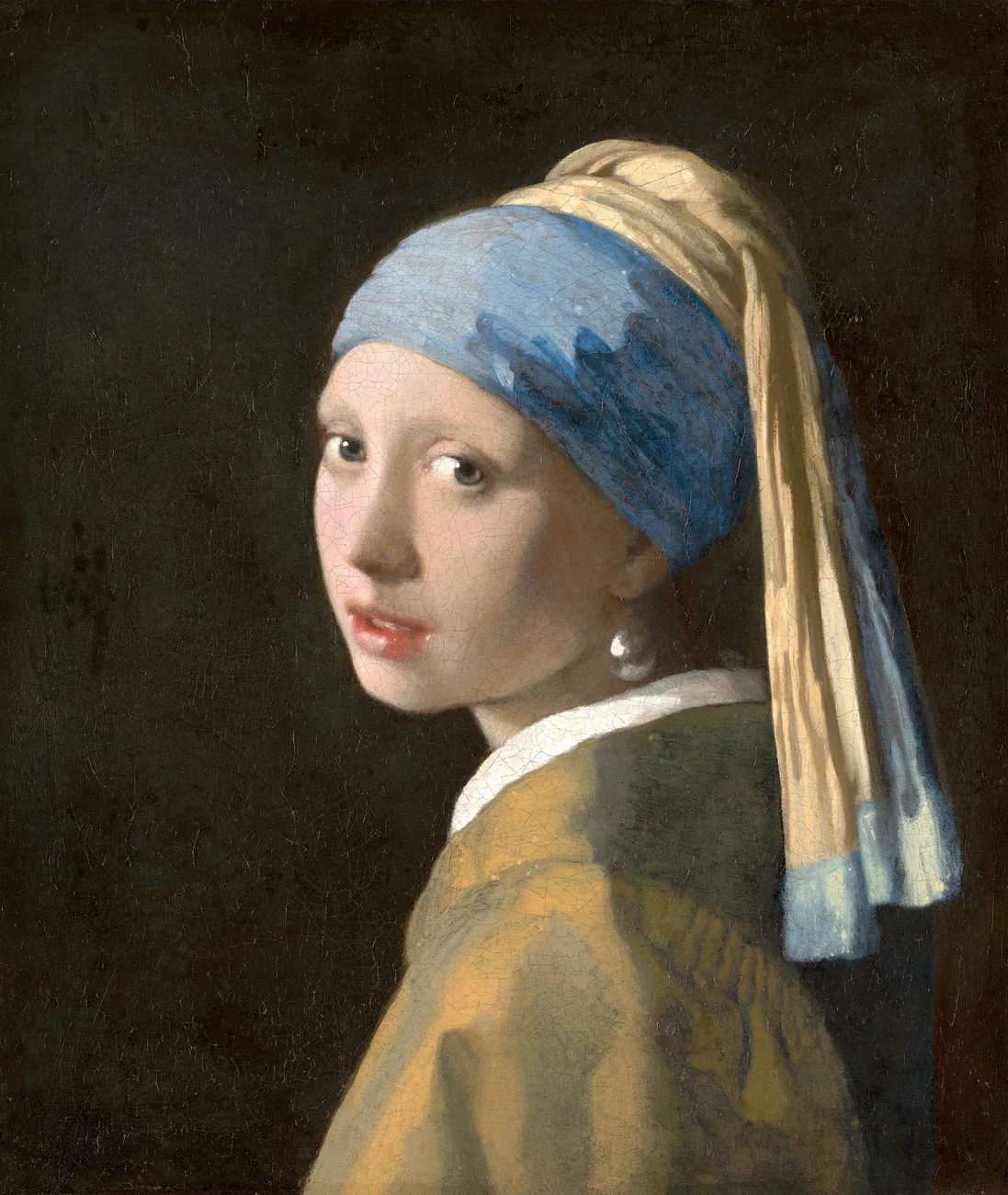
Girl with a Pearl Earring is one of the most familiar images in Dutch Golden Age painting, but its scale is surprisingly modest. The original is oil on canvas, 44.5 by 39 cm, or about 17.5 by 15.4 inches. It is held by the Mauritshuis in The Hague. On a wall it can feel larger than life because Vermeer brings the face close to the viewer and leaves almost nothing around it to dilute the encounter.
The Mauritshuis calls the work a tronie, not a portrait. A tronie is an imagined figure or character study, in this case a young woman in exotic dress rather than a documented sitter presented for a patron. That distinction matters when you look at the picture. The appeal is not the biography of a known person. It is the turn of the head, the parted lips, the direct but unreadable gaze, and the way light makes a few areas of color feel startlingly alive.
For a collector or designer, the small original creates a useful decision. A near-original-size reproduction can feel intimate and almost object-like. A larger canvas can turn the image into a quiet focal point for an entry, study, bedroom, suite, or reception area. The proportion should remain close to the original: a vertical rectangle that is nearly square, rather than a generic narrow portrait format.
The Mauritshuis collection record is the source for the artwork facts on this page. It is not a claim of museum affiliation, and this new canvas is always described as an unsigned hand-painted reproduction.
Dutch Golden Age light, sfumato, and the green curtain behind the Girl
Vermeer did not make the face persuasive by outlining every feature. The Mauritshuis describes his soft, almost smoky transitions as sfumato. The edge of a nose dissolves into a cheek. The eyelids, lips, and jaw become clear because adjacent colors shift gradually, not because each feature is enclosed with a hard line. The viewer completes what Vermeer leaves unresolved.
The background is equally important. It is often described as black, but Mauritshuis research shows that it was originally a smooth, translucent dark green surface, built over a black underlayer with a green glaze. The green has changed with time, and the present image reads as deep and nearly black. A good reproduction should retain that depth without reducing it to flat black paint, which would make the face look cut out instead of illuminated from within a space.
The blue and yellow headscarf create the picture’s strongest color contrast. The blue holds the cooler side of the head in place; the yellow cloth and jacket give the composition warmth. Against the dark ground, the pale face, white collar, red lips, and earring do not need many details. Their restraint is exactly why they need careful control.
The pearl in Vermeer’s painting: a few strokes, not a drawn object
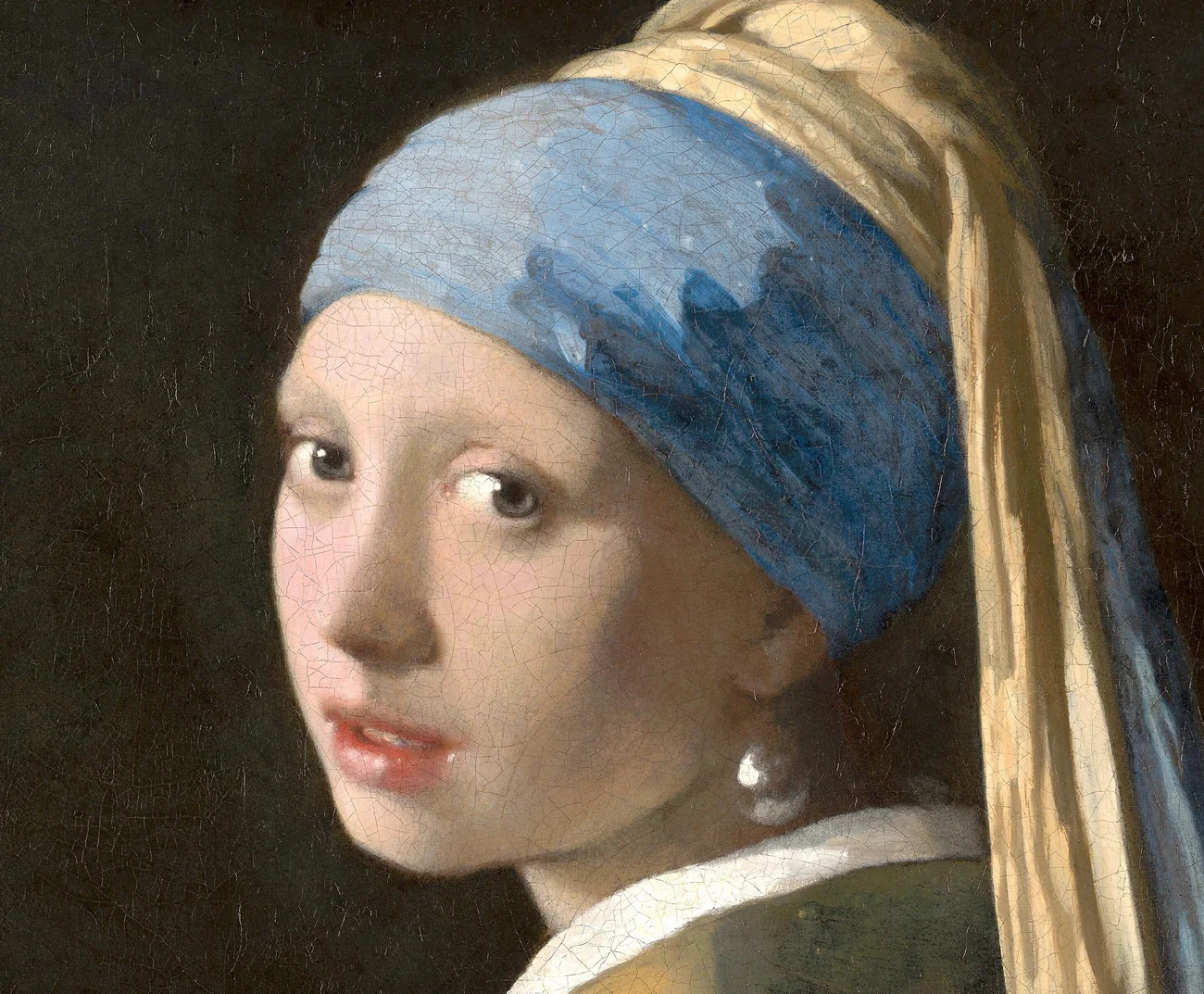
The earring may not be a literal pearl at all. The Mauritshuis notes that it is unusually large, has no visible hanger, and may have been an imitation object. More important for a hand-painted reproduction is how Vermeer made it appear luminous. A thin grey layer establishes its shape, then a small number of deliberate white touches make it read as a droplet catching light.
That economy is easy to lose. If the earring is painted with a hard outline, too much white, or too much texture, it becomes a bead placed on top of a portrait. If it is too faint, the painting loses its focal point. The pearl has to feel suspended between solid object and reflected light. The same principle applies to the small wet-looking note on the lower lip and the highlights at the eyes.
Why a hand-painted Vermeer reproduction is difficult to paint
This is not a painting that improves when every feature is made sharper. A convincing hand-painted Vermeer reproduction depends on relationships that are easy to overstate and hard to bring back once they are lost.
- The face needs soft edges without becoming vague. Cheek, nose, eye, jaw, and neck must shift into one another. Strong contour lines make the face look illustrated rather than illuminated.
- The dark ground has to keep depth. A pure black background flattens the work. The surrounding dark should feel deep enough to bring the lightest areas forward.
- Blue and yellow need separation. The headscarf and yellow fabric make the face feel warmer by contrast. If the colors are muddied where they meet skin, the freshness of the image disappears.
- The pearl needs restraint. It is a small, light-based effect. Oversized texture, a bright ring, or a heavy white dot makes it read as a decorative sticker.
- Enlargement changes the viewing distance. The original is only 44.5 cm high. On a larger canvas, transitions that are almost invisible in the museum must remain subtle enough to work from both near and far.
How PaletteMomento paints Girl with a Pearl Earring
One painter is responsible for the full canvas. On a Vermeer subject, that matters because skin, dark ground, blue, yellow, and the small highlights have to belong to one consistent light decision from the first layer through the final review.
- Proportion and placement. We establish the nearly square portrait proportion, the turn of the head, the shoulder line, and the placement of the pearl before fine modeling begins.
- Dark ground and color structure. The background, headscarf, jacket, collar, and face are planned as related light and dark areas. This keeps the face from looking pasted over a flat background.
- Soft face and controlled highlights. The skin is built with quieter transitions than the clothing. The eye, lower lip, and earring are resolved as small light events rather than as heavily outlined details.
- Progress and daylight review. Photos and short videos during painting let you see the work take shape. We then send daylight photographs of the finished hand-painted canvas for approval before release.
Acrylic is our standard material and is suitable for a clear, layered reproduction. Oil is available on request for buyers who want a hand-painted oil painting reproduction. Oil needs more time between layers, so the production schedule is longer. Neither option is a printed image or an artificial texture layer over a print.
How to tell a hand-painted Vermeer from a canvas print
Product photography can make a textured print look painted. For this particular image, the question is whether surface changes follow Vermeer’s design or appear as one repeated layer across the canvas.
- Compare face and background. The face should have soft, measured transitions while the background stays visually quieter. Uniform gloss or raised texture across both areas is a warning sign.
- Look closely at the pearl. On a hand-painted version, its grey body and white highlight should sit within the surrounding light logic. A printed dot stays optically flat under close inspection.
- Check the headscarf edges. Blue, yellow, collar, and skin should meet with intentional changes in paint coverage, not a mechanical edge followed by a clear coating.
- Examine the canvas edge. On a stretched hand-painted canvas, color and brushwork continue naturally around the edge. A printed image often ends with a more uniform boundary.
PaletteMomento paints every reproduction by hand on premium linen. We do not print an image, and we do not add texture over a print.
Girl with a Pearl Earring reproduction sizes, materials, and framing
The original is 44.5 by 39 cm, a portrait format with a width-to-height ratio close to 0.88. Custom sizes such as 21 by 24 inches, 28 by 32 inches, 35 by 40 inches, and 42 by 48 inches keep close to that shape. A 24 by 28 inch or 28 by 32 inch canvas gives the subject presence without changing the quiet scale of the original. Larger sizes can work for a hotel, lobby, stair landing, or broad wall, but the head becomes more immediate as it grows.
Send the usable wall width and height, room type, and any nearby furniture. We will help you settle the size before painting begins. PaletteMomento offers 60 standard sizes from 24 by 20 to 80 by 60 inches, along with custom measurements. A proportion outside the standard list is quoted for the wall rather than forced into a generic rectangle.
Acrylic
Acrylic is our standard material. It is a practical choice for a layered portrait when a project has a defined installation date.
Oil
Oil is available on request for buyers who specifically want an oil painting reproduction. It allows a longer working time between applications and therefore needs a longer schedule.
Stretched canvas
Stretched canvas is ready to hang and keeps the portrait proportion stable. It is usually the right choice for an individual piece.
Framed or rolled
Black, white, wood, silver, or gold framing gives a finished look. Rolled canvas can suit larger project orders and needs careful restretching at its destination.
Girl with a Pearl Earring for interior designers, hospitality, and commercial spaces
This work is not limited to a traditional study or a bedroom. An interior designer may use one near-square portrait to give a stair landing or entry a human focal point. An art consultant may pair it with related Dutch Golden Age works. A hotel, restaurant, club, office, retail setting, model home, clinic, or event venue may use it as a quiet contrast to busier public spaces.
Interior designers and art consultants
Send the wall dimensions, an interior image, and the frame finish you have in mind. A slim black frame lets the dark ground feel more contemporary. Wood brings warmth, while gold can echo the yellow passages of the painting. For a group of related works, we can keep canvas size and finish consistent across the order.
Hospitality, workplace, and public-facing interiors
The subject is recognizable from a distance but gives more to a viewer who comes close. That suits hotel suites, reception areas, lounge corridors, private dining rooms, library-style spaces, offices, retail, and healthcare waiting rooms. It can stand on its own or be paired with other public-domain works through our Vermeer reproductions page.
Quantities, samples, and timing
There is no minimum order. Trade rates improve at 6 pieces and again at 21, with mixed designs counted together. Production is usually 7 to 10 business days for 1 to 5 pieces, 10 to 15 business days for 6 to 20 pieces, and 15 to 20 business days for 21 to 50 pieces. Larger canvases and oil sit toward the longer end of their production band. For a first order or larger project, a sample can be painted first, with the sample cost credited back on an order of 10 pieces or more.
For a trade quote, send the artwork, dimensions, quantity, finish, destination, and installation date. WhatsApp replies are usually immediate; email replies usually arrive within 12 hours. Our trade page explains the wider project process.
Is Girl with a Pearl Earring by Vermeer in the public domain?
Yes. Johannes Vermeer died in 1675, and Girl with a Pearl Earring was made around 1665. The work is in the public domain under the United States and European Union conditions used for PaletteMomento reproductions. Public-domain status allows a new hand-painted reproduction.
It does not allow a new canvas to be presented as the original or as an object connected with the Mauritshuis. Every PaletteMomento version is unsigned and described as a hand-painted reproduction. We do not copy Vermeer’s signature or monogram, imitate age, or claim museum affiliation.
Girl with a Pearl Earring reproduction FAQs
Is Girl with a Pearl Earring a portrait?
What size is the original Girl with a Pearl Earring?
Is this a hand-painted Vermeer reproduction or a canvas print?
Can Girl with a Pearl Earring be painted at a custom size?
Should I choose oil or acrylic for a Vermeer reproduction?
Is the earring a real pearl in Vermeer’s original?
Will I see my hand-painted Vermeer before it ships?
Is Girl with a Pearl Earring in the public domain?
No minimum order. WhatsApp replies are usually immediate; email replies usually arrive within 12 hours.