Order a hand-painted canvas interpretation of Katsushika Hokusai’s The Great Wave off Kanagawa, made on premium linen in acrylic or oil at a custom landscape size that keeps the original proportion. Hokusai’s image began as a woodblock print, not an oil painting. Our artists translate its line, Prussian blue, and foam into paint without pretending the canvas is an original print. Nothing is printed. We share photos and short videos as the painting goes, then send daylight photographs of the finished canvas for your approval before it ships.
Hokusai’s Great Wave: the original ukiyo-e woodblock print
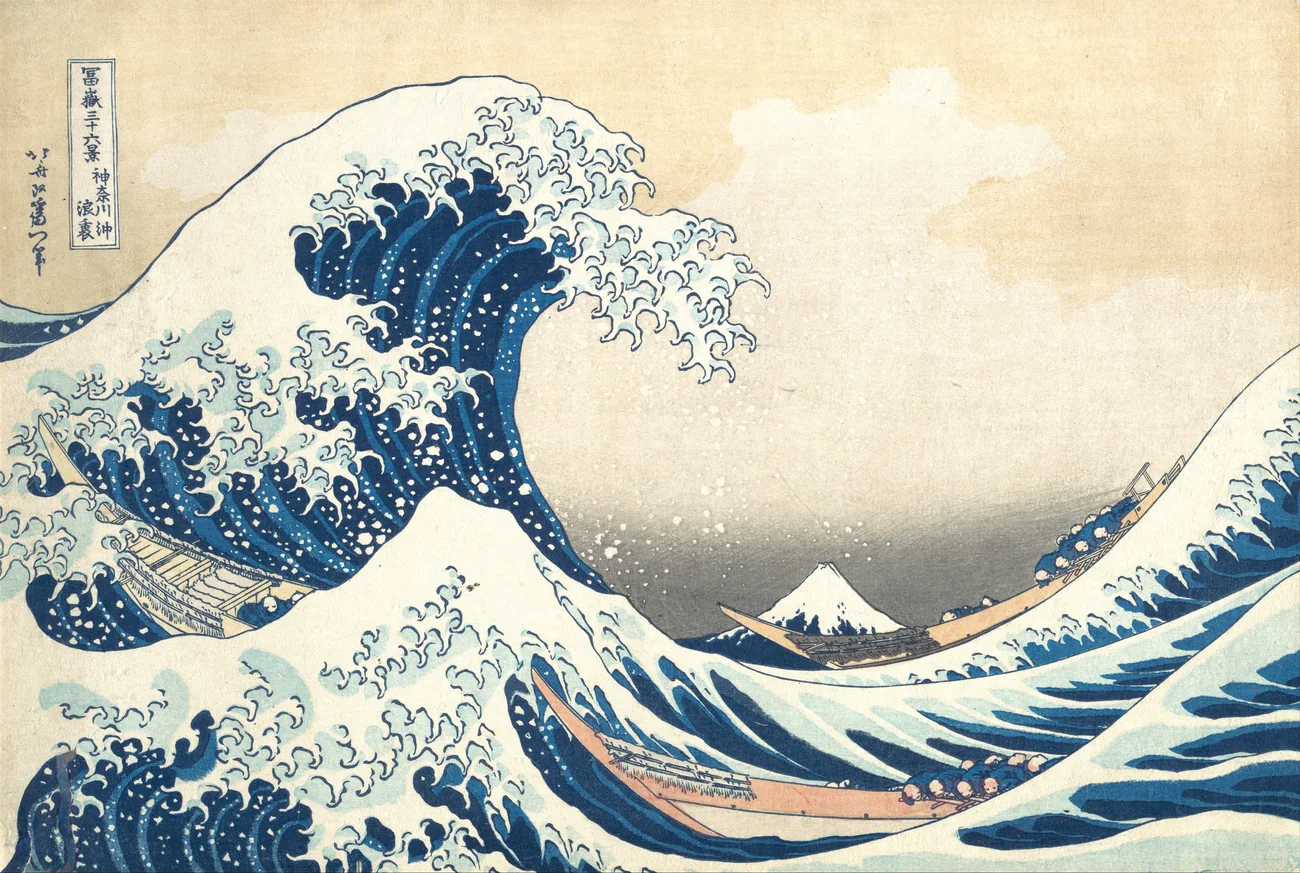
The image most people call The Great Wave is properly titled Under the Wave off Kanagawa. Hokusai made it around 1830 to 1832 for his series Thirty-six Views of Mount Fuji. The Metropolitan Museum of Art records its example as a woodblock print in ink and color on paper, measuring just 25.7 by 37.9 cm, or about 10 1/8 by 14 15/16 inches.
That small scale is worth understanding before ordering a large canvas. There is no oil original to reproduce brushstroke for brushstroke. There are printed impressions, each made from carved blocks. A hand-painted Great Wave is therefore a new canvas interpretation of Hokusai’s design. It can be true to the composition, palette, line, and proportion, while remaining honest about the change of medium.
The image is one of the clearest demonstrations of Hokusai’s control of scale. Three narrow boats sit low in the picture. Mount Fuji appears as a small pale triangle inside the hollow of the vast cresting wave. The wave is not only a dramatic subject. It is also a device that makes a distant mountain feel unexpectedly close.
For the underlying artwork facts and a public-domain reference image, see the Met collection record. Its public-domain designation is useful for a new hand-painted reproduction, but it does not turn a new canvas into a historic Hokusai impression.
Why The Great Wave off Kanagawa became an icon of Japanese art
The Great Wave is an ukiyo-e landscape, yet it does not behave like a quiet view of a mountain. The large curling wave, the small boats, and Mount Fuji create a sequence the eye reads quickly from across a room. Up close, the picture is more measured: the white foam breaks into small hooked forms, the boats form steady diagonals, and the mountain remains calm inside the movement.
Blue is central to the image. The Met’s conservation research explains that the printers combined imported Prussian blue and indigo, then printed some passages twice to deepen the hollow of the wave without simply making it black. That is part of why cheap versions so often feel wrong: the water becomes a single dark blue, the line disappears, and the foam turns into a generic splash.
The original print was a product of collaboration between design, carving, printing, and publishing. A hand-painted canvas cannot recreate that process exactly. It can, however, respect what made the print visually powerful: the clean division of color, the particular balance of dark and bright blue, the precision of the outlines, and the modest size of Fuji against the sea.
From Hokusai’s woodblock print to a hand-painted Great Wave canvas
A print and a hand-painted canvas answer different needs. If you want the original medium’s flat ink, paper grain, and small historical scale, a well-produced print is the more faithful choice. If you need a larger wall piece, a custom landscape proportion, or a surface with visible handwork, a canvas interpretation makes sense.
PaletteMomento does not print a base image and paint texture over it. Each canvas is painted by hand. We keep the drawing and color relationships close to the selected reference, while deciding with you how much texture the translation should have. The most convincing version is not necessarily the thickest one. This work relies on flat color and precise line as much as it relies on the drama of the foam.
Why a hand-painted Great Wave reproduction is difficult to paint well
The image is familiar enough that even small mistakes are easy to see. These are the decisions that determine whether a Great Wave canvas keeps Hokusai’s rhythm rather than becoming generic ocean decor.
- The landscape proportion has to be protected. The Met impression is roughly 1.47 times wider than it is high. A square or tall crop cuts into the visual pause around Fuji and changes the pressure of the wave.
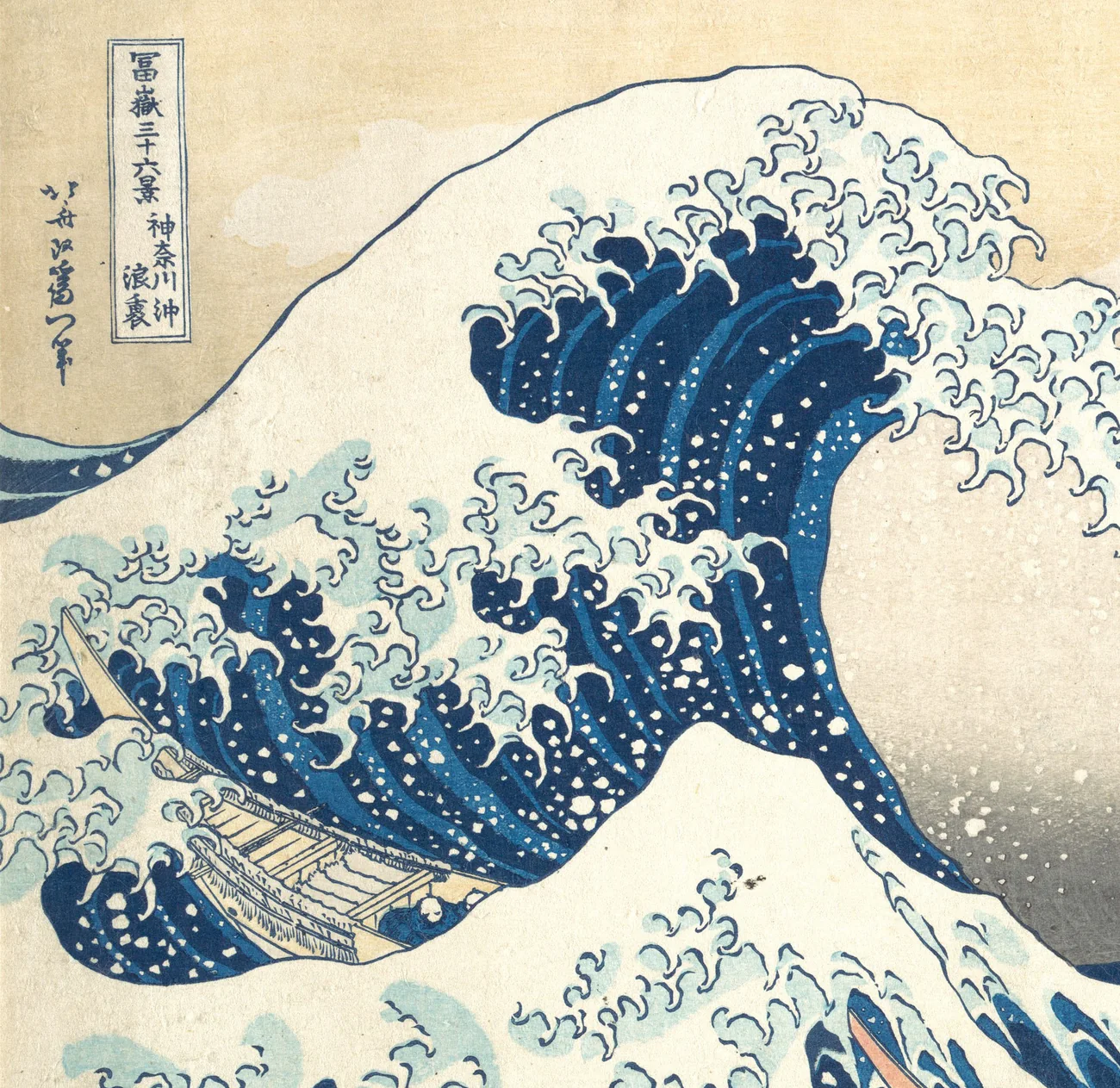
- The foam needs separate, controlled forms. The white tips are often described as claws. They need to read as many clear marks, not one soft mass of white paint.
- Dark water must remain blue. The contrast comes from Prussian blue, indigo, and carefully separated bands of color. If the hollow of the wave becomes black, the print’s energy disappears.
- Mount Fuji cannot be lost. It occupies little space, but it gives the composition its scale and stillness. A large wave with an oversized or misplaced mountain does not feel like Hokusai’s image.
- Texture must follow the image. Raised paint can work in the foam, but thick texture across sky, boats, and flat water changes a woodblock design into something else entirely.
How PaletteMomento paints The Great Wave off Kanagawa
One painter is responsible for the completed canvas. For a work built on coordinated outlines and color fields, that continuity matters more than piling texture onto the surface.
- Reference, proportion, and drawing. We begin with a high-resolution public-domain reference and set the landscape proportion before the drawing is transferred to the chosen canvas size. The boats, Fuji, and the outer contour of the wave are checked together.
- Sky and flat blue passages. The sky and water are established as clear color fields. The aim is a smooth visual structure that still leaves room for the deeper blue hollow and the white foam.
- Lines, boats, and foam. The fine divisions of the boats and water are painted by hand. The foam is built last so its small forms stay legible against the blue rather than sinking into it.
- Surface choice and final review. We keep the canvas flat and graphic, or add controlled texture where it suits the foam. We share photos and short videos as the work develops, then send daylight photographs of the finished canvas for approval before release.
Acrylic is the standard material for this design because it can keep color fields and hard edges clean. Oil is available on request for buyers who prefer the original painting medium for their new canvas, understanding that Hokusai’s own work was not oil and that oil adds time between layers.
Hand-painted Great Wave canvas or print: which is right for you?
This is a better question than asking whether one format is universally better. The original was designed as a print, and a print can be an excellent choice. A hand-painted canvas adds scale, a made-to-order surface, and the chance to tune the finish to a room. It also changes the object.
- Choose a print if you want the closest link to ukiyo-e’s flat inks and paper surface, need a small-scale work, or prefer a highly uniform image.
- Choose a flat, hand-painted canvas if you need a larger custom size but want the graphic discipline of the print preserved.
- Choose a lightly textured canvas if the work will be viewed close up and you want the foam to catch light while the sky and water remain comparatively calm.
- Choose an oil version only if an oil painting reproduction is important to your project. It is a deliberate medium choice for the new canvas, not a claim about Hokusai’s original.
The distinction is visible in the surface. A modern canvas print resolves as ink on a repeated substrate. A hand-painted canvas has line and paint variation that follow the wave, boats, and foam. It should not have one uniform clear texture covering every part of the image.
Great Wave reproduction sizes, proportion, finish, and framing
The original sheet is small, but its landscape proportion enlarges well. For most walls, 36 by 24 inches, 48 by 32 inches, 60 by 40 inches, and 72 by 48 inches keep close to the original relationship of width to height. If your wall calls for another size, we can quote a custom landscape canvas rather than force the design into a square or a tall rectangle.
Send the usable wall width and height, the room type, and an interior image if you have one. That lets us recommend a size before painting begins. A 36 by 24 inch piece suits a study, entry, or small dining wall. A 60 by 40 inch or 72 by 48 inch piece has the presence needed for a lobby, restaurant wall, office reception, or broad living-room wall.
Flat and graphic
Smooth color fields, crisp outlines, and minimal texture. This is the closest hand-painted option to the visual logic of the original print.
Light foam texture
Controlled raised paint in the white spray only. The foam gains a changing surface while sky and water retain their necessary calm.
Acrylic or oil
Acrylic is standard and suits clean edges. Oil is available on request for buyers who want a slower, more layered surface on the new canvas.
Stretched, framed, or rolled
Stretched or framed canvas is ready to hang. Rolled canvas can suit larger flat-finish orders; heavily textured work should be stretched or framed for safer handling.
Great Wave reproductions for hospitality, restaurants, and commercial interiors
The Great Wave works for more than Japanese restaurants or Japandi rooms. Its color and strong silhouette can anchor a coastal hotel, a spa corridor, a bar, an office reception, a retail setting, a model home, or a restaurant wall. It also gives art consultants and interior designers a recognizable image whose scale can be planned around a specific wall.
Interior designers and art consultants
Send the wall dimensions, quantity, finish, and intended frame color. We can help keep the landscape proportion consistent across a single statement piece or a group of related Japanese art reproductions. Black, white, wood, silver, and gold framing are available at the same price.
Hospitality, food, retail, and workplace projects
A graphic flat finish can work especially well where the piece is seen from a distance. A lightly textured finish gives more interest in a lounge, reception area, or corridor where guests pass close by. We plan around quantity, destination, installation date, canvas depth, and finish instead of treating every commercial order as a single residential canvas.
Quantities, samples, and timing
There is no minimum order. Trade rates improve at 6 pieces and again at 21, with mixed designs counted together. Production is usually 7 to 10 business days for 1 to 5 pieces, 10 to 15 business days for 6 to 20 pieces, and 15 to 20 business days for 21 to 50 pieces. Larger canvases, oil, multi-panel layouts, and more texture sit toward the longer end of their production band. For a first order or larger project, a sample can be painted first, with the sample cost credited back on an order of 10 pieces or more.
For a trade quote, send the artwork, dimensions, quantity, finish, destination, and installation date. WhatsApp replies are usually immediate; email replies usually arrive within 12 hours. Our trade page explains the wider project process.
Is Hokusai’s Great Wave off Kanagawa in the public domain?
Yes. Katsushika Hokusai died in 1849, and Under the Wave off Kanagawa was published around 1830 to 1832. The work is in the public domain under the United States and European Union conditions used for PaletteMomento reproductions. That permits a new hand-painted canvas interpretation.
It does not permit a new canvas to be presented as a historic Hokusai impression or as a museum-associated object. Every PaletteMomento version is unsigned and described as a hand-painted reproduction. We do not copy Hokusai’s signature or inscriptions, imitate age, or claim museum affiliation. You can explore related works through our Hokusai reproductions page.
The Great Wave off Kanagawa reproduction FAQs
Is The Great Wave off Kanagawa a painting?
Is this a hand-painted Great Wave canvas or a canvas print?
What size is Hokusai’s original Great Wave?
Can I order a custom-size Great Wave reproduction?
Should a Great Wave canvas be flat or textured?
Should I choose oil or acrylic for a Great Wave reproduction?
Will I see my hand-painted Great Wave before it ships?
Is The Great Wave off Kanagawa in the public domain?
No minimum order. WhatsApp replies are usually immediate; email replies usually arrive within 12 hours.