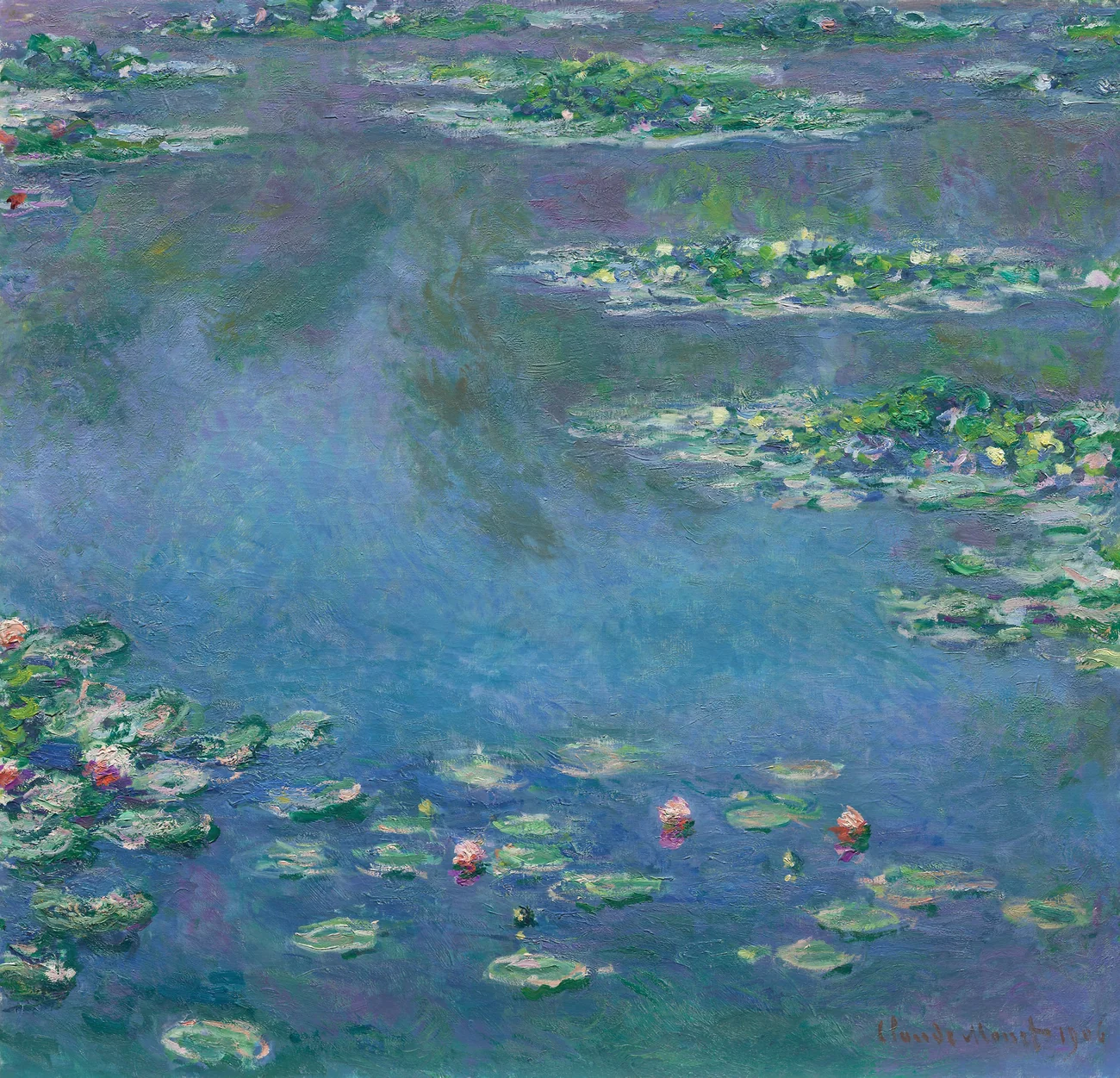
Order a hand-painted Claude Monet Water Lilies reproduction on premium linen, in acrylic or oil, at the original near-square proportion or a custom size for your wall. The default reference here is Monet’s 1906 canvas at the Art Institute of Chicago. Because Water Lilies is a series rather than one fixed image, send the exact museum link or image if you mean another version. One painter takes each canvas from drawing through the final passages. Nothing is printed. We share photos and short videos as the painting goes, then send daylight photographs of the finished canvas for your approval before it ships.
Monet’s Water Lilies: a series, not one fixed painting
“Water Lilies” can sound like the title of one universally recognised picture. It is actually the name used for a long sequence of Monet paintings made from his pond at Giverny. The paintings differ radically in date, colour, crop, and proportion. Some are compact and near-square; others are broad horizontal fields of water, reflection, and floating vegetation. A convincing reproduction starts by identifying the particular work, not by treating the series as a decorative pattern.
The default here is Water Lilies of 1906, an oil on canvas measuring 89.9 by 94.1 cm, or roughly 35.4 by 37 inches. It belongs to the Art Institute of Chicago. Its nearly square shape makes it suitable for a quiet, self-contained focal point on a bedroom, reception, treatment-room, or entry wall. The work is not simply a pond scene: the surface of the water, its reflected light, and the pads all carry the composition.
If you have a different Monet in mind, please do not rely on the title alone. Send a link, screenshot, or museum object number with your enquiry. A 1919 Water Lilies at The Met, for example, is 101 by 200 cm, a dramatically different horizontal format. We can review a specific public-domain source before quoting it. If your aim is an original water-lily composition rather than a reproduction of one named work, start with our custom art service instead.
The Art Institute of Chicago’s Monet catalogue entry is the source for the default-work facts on this page. It does not suggest museum affiliation. Every PaletteMomento version is a new, unsigned hand-painted reproduction.
Monet’s Water Lilies and Impressionism: Giverny, reflection, and near-abstraction
Monet had his pond dug and planted with lilies at Giverny in 1893. From 1899 onward, he returned to it again and again. At first glance the subject feels restful: water, leaves, flowers, light. But the late work does something more ambitious. It withdraws the usual horizon and stable viewpoint. Trees, sky, and surrounding plants appear mainly as broken reflections in the water, while the lily pads make the surface feel close to the viewer.
That is why the series matters in the history of Impressionism. Instead of presenting a landscape as a clear window onto distant space, Monet lets colour, brushwork, and changing light become the subject. The Met describes his late approach as a fluid, audacious style in which the pond becomes the departure point for almost abstract art. A Water Lilies canvas can look atmospheric from across a room and become far less literal as the viewer steps close.
The 1906 work sits in an important middle period. It has enough recognisable lily pads and reflected foliage to establish the pond, yet it also asks the eye to assemble the scene from separate strokes and colour intervals. That combination is a large part of the appeal for contemporary interiors: it has a familiar art-historical identity without behaving like a tightly drawn botanical illustration.
Why a Monet Water Lilies reproduction is difficult to paint well
“Impressionist brushwork” is not a shortcut. On this subject, an abundance of random dabs quickly turns the water into wallpaper. The hand-painted version has to hold several relationships together at once.
- Water has to remain a surface. Reflected foliage and sky should appear to lie within the water, not behind it like a conventional landscape background.
- Lily pads need placement, not repetition. Their scale, spacing, and direction guide the eye across the canvas. Even a small change in their distribution can make the composition feel congested or empty.
- Broken colour must still form a value structure. Blue, green, violet, pink, and dark reflected tones need enough separation to read from a distance while remaining alive at close range.
- Brushwork must follow the motif. The paint language for water, reflection, foliage, and a floating pad is related but not identical. One uniform texture across the whole surface loses Monet’s shifting rhythms.
- Scale changes the decision. Enlarging a 1906 near-square canvas gives each mark more physical presence. The painter must preserve the overall balance without turning small accents into heavy decoration.
How PaletteMomento paints a hand-painted Monet Water Lilies canvas
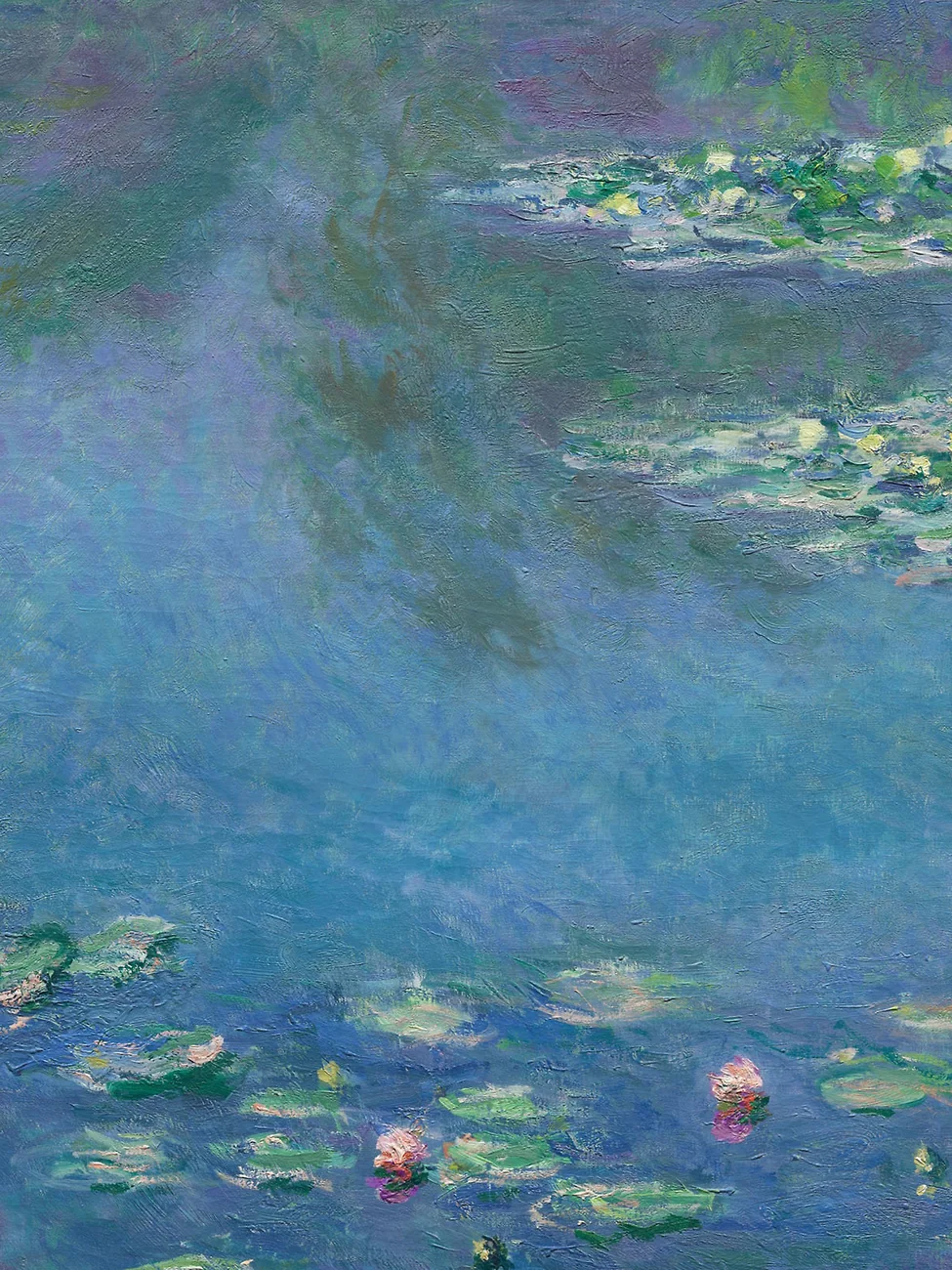
One painter is responsible for the complete canvas. That continuity matters here because the wide colour field, reflected darks, pads, and final highlights must belong to a single decision about light and depth.
- Identify the reference and proportion. We confirm whether the request is for the 1906 Art Institute canvas or another named version, then set the composition at the chosen near-square or horizontal ratio.
- Establish the large water and reflection structure. The initial layers place the broad dark and light relationships before individual pads or blossoms distract from the surface of the pond.
- Build colour through related passages. Water, reflected foliage, and cooler or warmer areas are developed as connected patches of colour. The aim is visual depth, not a photographic copy of every small mark.
- Resolve pads and final accents. The last passages bring the floating forms into focus without outlining them mechanically or spreading the same raised texture everywhere.
- Share the finished work before release. Photos and short videos during painting show the work taking shape. We then send daylight photographs of the finished hand-painted canvas for your approval before it ships.
Acrylic is our standard material and suits a layered, hand-painted Impressionist reproduction. Oil is available on request for buyers who specifically want an oil painting reproduction, as Monet used. Oil needs longer between layers, so the production schedule is longer. In either material, this is a fresh painting after Monet, not an aged object and not a reproduction print with a texture coating.
How to tell a hand-painted Monet Water Lilies from a canvas print
A good photograph can make a canvas print and a hand-painted surface look similar from a distance. The difference is easier to see when the paint changes are judged against the composition rather than by texture alone.
- Look for directional decisions. In a hand-painted version, brush movement changes between the layered water, reflected foliage, and floating pads. A repeated surface pattern does not make those distinctions.
- Compare quiet and active areas. The image needs places where colour is allowed to breathe as well as more concentrated passages. Equal gloss or equal relief over every centimetre is not evidence of deliberate paint structure.
- Inspect the pad edges. A hand-painted pad may be formed with a loaded, broken, or partly lost stroke. A print preserves an optical image but remains flat when examined as paint.
- Check the canvas edge. On a stretched hand-painted canvas, colour and brushwork continue naturally around the edge. A printed image more often has a mechanically uniform boundary or a separate coating.
PaletteMomento paints each reproduction by hand on premium linen. We do not print an image, and we do not add texture over a print.
Water Lilies reproduction sizes: the 1906 square, panoramas, and triptychs
The 1906 original is close to square, with a width-to-height ratio of about 1.05. A square or near-square canvas respects its composition better than forcing it into a tall portrait or a long rectangle. Sizes such as 24 by 24, 30 by 30, 36 by 36, 40 by 40, or 48 by 48 inches can work depending on the wall and viewing distance. A custom near-square measurement can stay still closer to the original proportion.
For a long wall above a sofa, reception desk, or corridor, first decide whether you want a specific horizontal Monet, such as one of the later Water Lilies paintings, or a separate custom-art commission. A near-square 1906 painting should not simply be stretched sideways. When the source itself is panoramic, a diptych or triptych can make transport and installation easier while keeping one continuous image across the panels.
Near-square 1906 canvas
Best for the default Art Institute reference. It keeps the close, balanced field of water and pads intact for a single wall focal point.
Large single canvas
Useful where the painting needs to hold a broad entry, lounge, clinic, or lobby wall. The chosen size should allow the colour field to read from a comfortable distance.
Specific panoramic Water Lilies
Choose this when you have identified a named horizontal Monet reference. Send the exact image so we confirm the source, crop, and proportion before painting.
Diptych or triptych
A practical option for a long feature wall when the source image is horizontal. We plan the panel gaps with the final installation width in mind.
Send the usable wall width and height, room image, furniture below the wall, quantity, and desired finish. PaletteMomento offers 60 standard sizes from 24 by 20 to 80 by 60 inches as well as custom measurements. We will help establish the right format before painting begins rather than forcing the reference into a generic rectangle.
Oil or acrylic for a Monet Water Lilies reproduction?
Monet painted the original in oil, and oil is available on request when matching the original material is important to the buyer. Its slower drying time gives the painter a longer working window between applications, but it also means a longer production schedule. It can be a good choice for an individual collector, a slower-moving project, or a brief that specifically calls for an oil painting reproduction.
Acrylic is PaletteMomento’s standard material. It is appropriate for the layered colour and visible handwork required by a Monet subject, and it suits a project with a defined installation date. The important choice is not a claim that one material automatically looks “more artistic.” It is whether oil-as-original-medium or a more practical production timetable serves the project better.
Acrylic
Our standard material. A clear choice for a layered hand-painted canvas when a project has a defined installation schedule.
Oil
Available on request for buyers who want an oil painting reproduction. It needs more time between layers and therefore a longer schedule.
Stretched canvas
Ready to hang and well suited to individual installations, with the composition carried around the canvas edge.
Framed or rolled
Black, white, wood, silver, or gold framing gives a finished presentation. Rolled canvas can suit larger project orders and needs careful restretching at destination.
Monet Water Lilies reproductions for designers, consultants, and commercial interiors
Water Lilies is useful far beyond the home wall. Its atmosphere can give a hospitality lounge, restaurant, clinic, wellness space, office, retail setting, model home, senior-living common area, or reception a recognisable art-historical anchor without relying on a figurative subject. The difference between a calm near-square 1906 work and a panoramic late Monet matters to the layout, so the reference should be agreed early.
Interior designers and art consultants
Share the wall size, an interior image, colour references, frame preference, and installation date. We can advise on a near-square or horizontal source, canvas dimensions, and a finish that sits with the room. For a scheme with multiple pieces, matching canvas sizes and frame treatment can be planned across mixed designs.
Hospitality, workplace, healthcare, retail, and staging
The water-lily subject rewards both a passing glance and a closer look, which makes it effective in guest rooms, lobby seating, corridors, offices, waiting rooms, dining spaces, retail displays, and model homes. A project may use a single prominent piece or a coordinated set. Explore related options on our Monet reproductions page.
Quantities, samples, and timing
There is no minimum order. Trade rates improve at 6 pieces and again at 21, with mixed designs counted together. Production is usually 7 to 10 business days for 1 to 5 pieces, 10 to 15 business days for 6 to 20 pieces, and 15 to 20 business days for 21 to 50 pieces. Larger canvases, panel sets, and oil sit toward the longer end of their production band. For a first order or a larger project, a sample can be painted first, with the sample cost credited back on an order of 10 pieces or more.
For a trade quote, send the exact artwork reference, dimensions, quantity, finish, destination, and installation date. WhatsApp replies are usually immediate; email replies usually arrive within 12 hours. Our trade page explains the wider project process.
Is Monet’s Water Lilies in the public domain?
Yes. Claude Monet died in 1926, and the Water Lilies paintings were made during his lifetime. The works discussed here are in the public domain under the United States and European Union conditions used for PaletteMomento reproductions. That allows a new hand-painted reproduction of a qualifying public-domain source.
It does not allow a new canvas to be presented as an original Monet, as an aged historical object, or as a work connected to the Art Institute of Chicago or The Met. Every PaletteMomento version is unsigned and clearly described as a hand-painted reproduction after Monet. We do not copy a signature or claim museum affiliation.
Monet Water Lilies reproduction FAQs
Which Monet Water Lilies painting is the default on this page?
There are many Water Lilies paintings. Can I order another one?
Is this a hand-painted Monet Water Lilies reproduction or a canvas print?
Can a Water Lilies reproduction be painted at a custom size?
Can you make a panoramic or triptych Water Lilies canvas?
Should I choose oil or acrylic for a Monet reproduction?
Will I see my hand-painted Water Lilies before it ships?
Is Monet’s Water Lilies in the public domain?
No minimum order. WhatsApp replies are usually immediate; email replies usually arrive within 12 hours.