Japanese and Japandi rooms work by leaving things out. Bare wall, low furniture, soft daylight. In a room like that a printed canvas reads flat, because nothing else competes for your eye. A hand-painted surface holds the light instead. We paint every canvas by hand to order in our studio in Dafen Art Village, Shenzhen. Nothing here is printed. There is no minimum order, and any size you measure is painted at the same rate as our standard sizes.
Why a painted surface matters in a quiet room
Japanese interiors are built around ma, the empty space between things. One object on a wide wall, looked at closely, often for years. A print is an even film of ink on a flat sheet, and under the soft sideways light of a paper screen nothing catches. A hand-painted canvas has ridges and small changes in thickness, so the surface shifts through the day.
We paint in acrylic unless you ask for oil. Acrylic dries matte and stays matte, which suits a room of wood, paper and linen. Oil is available on request, and because it dries slowly between layers, oil pieces take longer. If you are curious how the layers go on before that choice matters, how we paint shows the steps.
| How it is made | Hand-painted to order in acrylic or oil on premium linen. Never printed. |
|---|---|
| Sizes | 60 standard sizes, 24 by 20 inches to 80 by 60 inches, plus sets of two and three. Any other size at the same rate. |
| Reproductions | Hokusai and Hiroshige only, because their work is public domain. All reproductions are unsigned. |
| Finish | Rolled in a tube, stretched on wood bars, or framed in black, white, wood, silver or gold. |
| Production | 7 to 10 business days for 1 to 5 pieces, 10 to 15 for 6 to 20, 15 to 20 for 21 to 50. |
| Minimum order | None. Trade pricing starts at one piece, improves at 6 and again at 21. |
The motifs we paint, and where each belongs
An honest map. Our catalog is deepest in wabi-sabi, minimalist and textured work, which is why those pieces are shown here. Wave, Fuji, sakura, crane, koi and brush-stroke pieces are painted as commissions from a reference we agree first.
Waves and Mount Fuji
A reproduction of a Hokusai or Hiroshige print, or a new composition inspired by ukiyo-e in your colors. Best on the widest wall.
Sakura
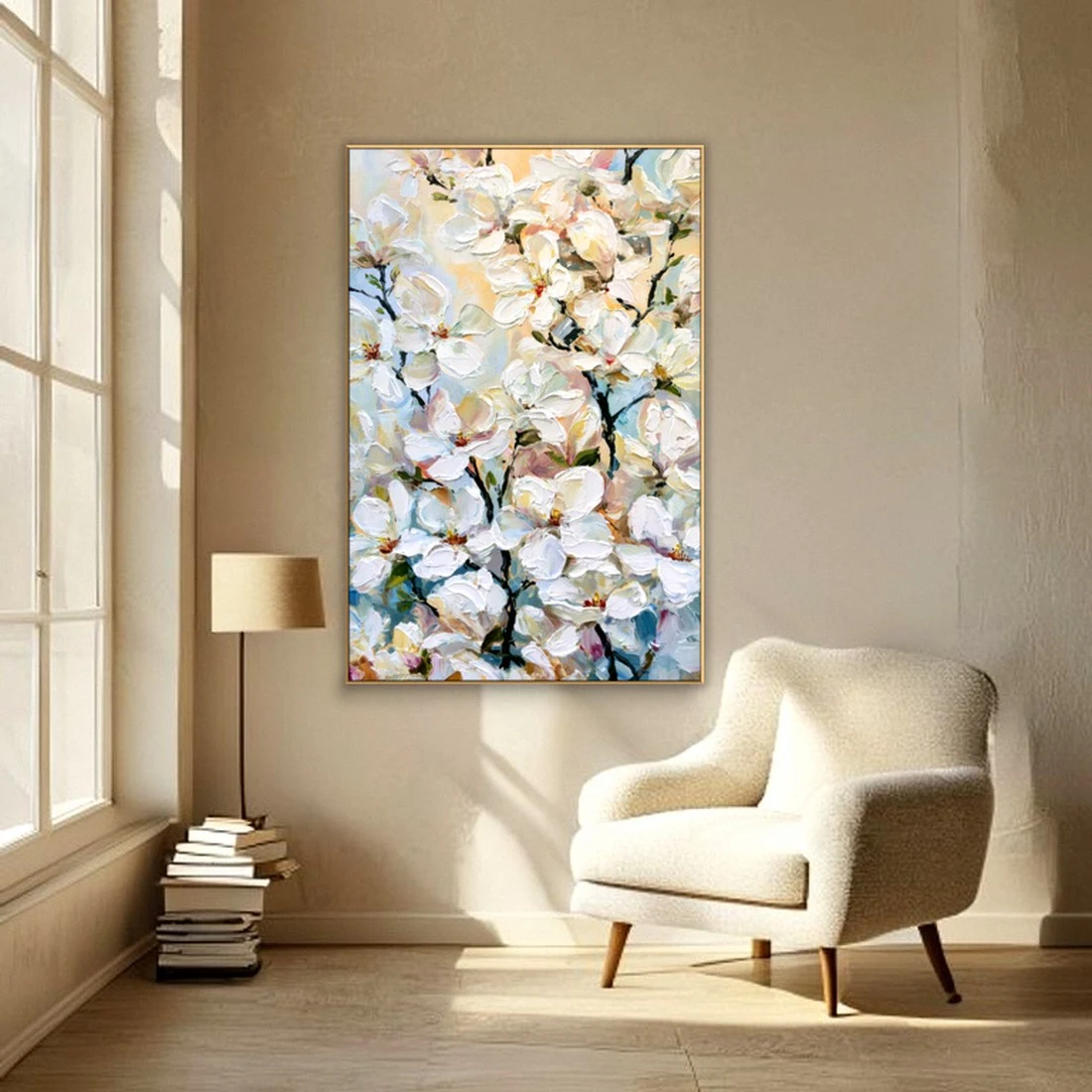
Cherry blossom in heavy texture, petals standing off the canvas. Pale reads calm in a bedroom, pink becomes the one bright thing in a neutral room.
Cranes and koi
Both suit a dining room, entry or hallway. Cranes carry an association with long life and are a common new-home gift, better in a shared room than a workspace.
Enso and brush strokes
One circle, or a few sumi-style strokes, on a mostly empty canvas. Good for a meditation room, a yoga studio or a bedroom.
Wabi-sabi texture
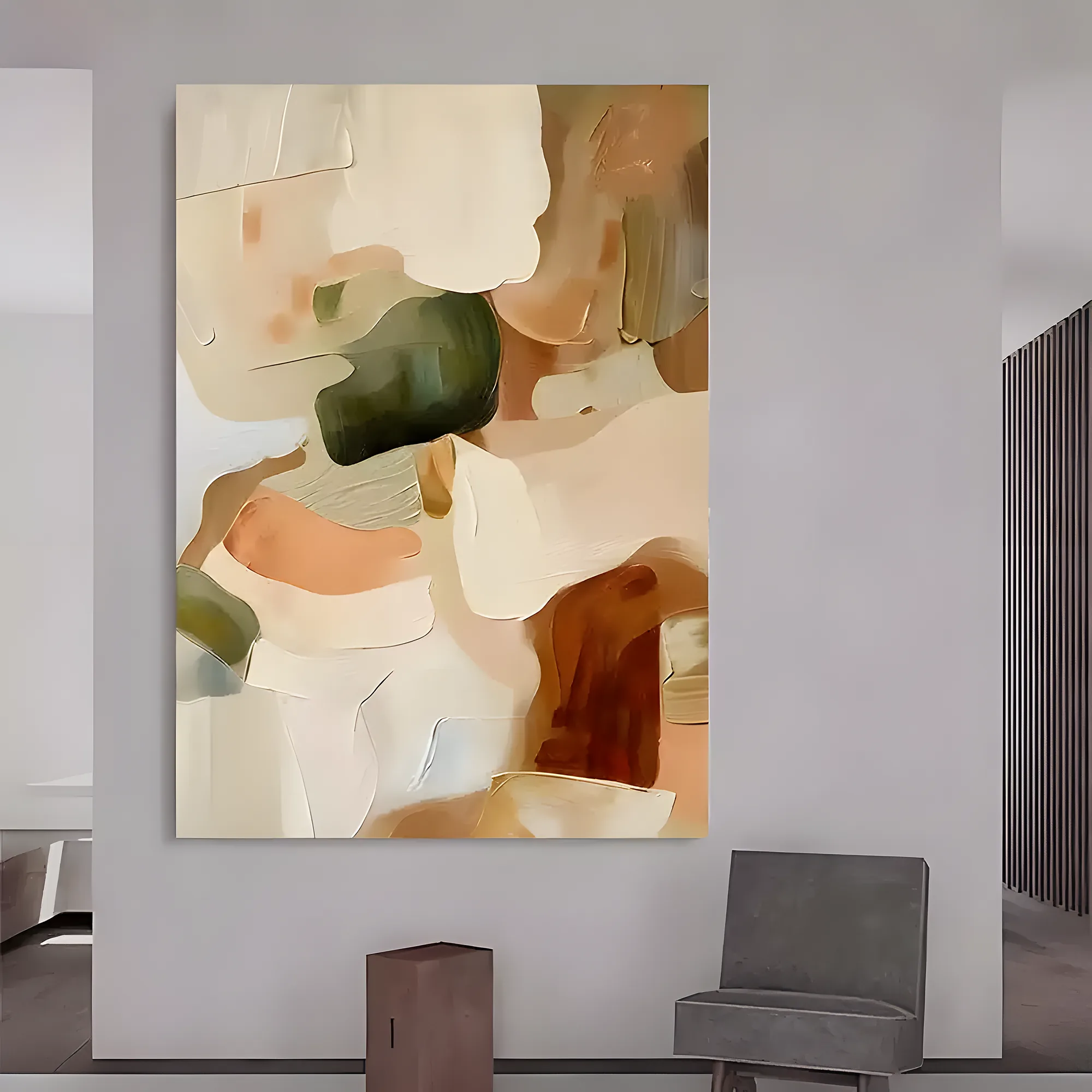
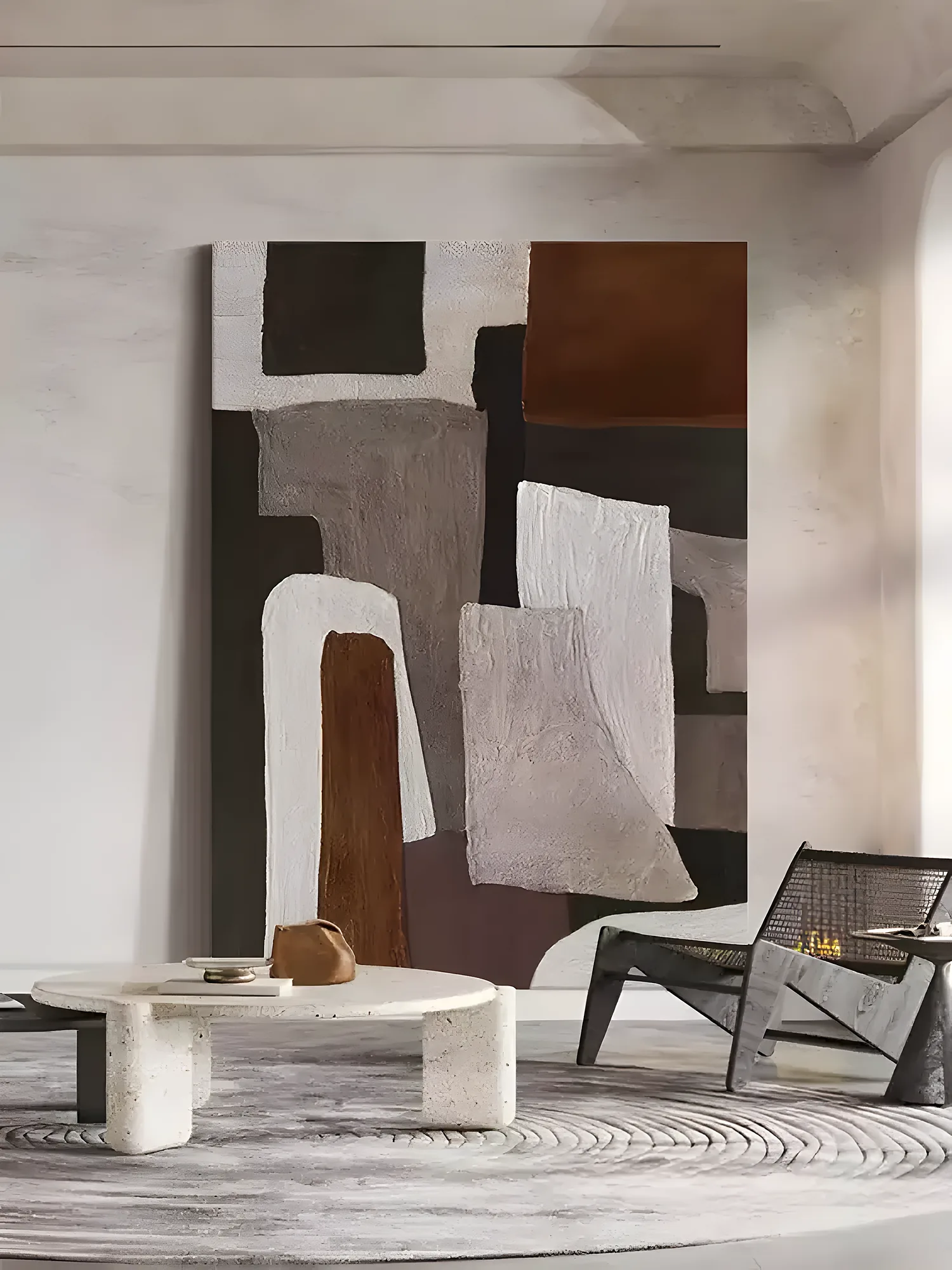
Torn shapes, plaster-like ridges and worn edges in beige, warm gray, off-white and ink black. Our strongest catalog area, and the easiest match for a Japandi room.
Quiet seascape
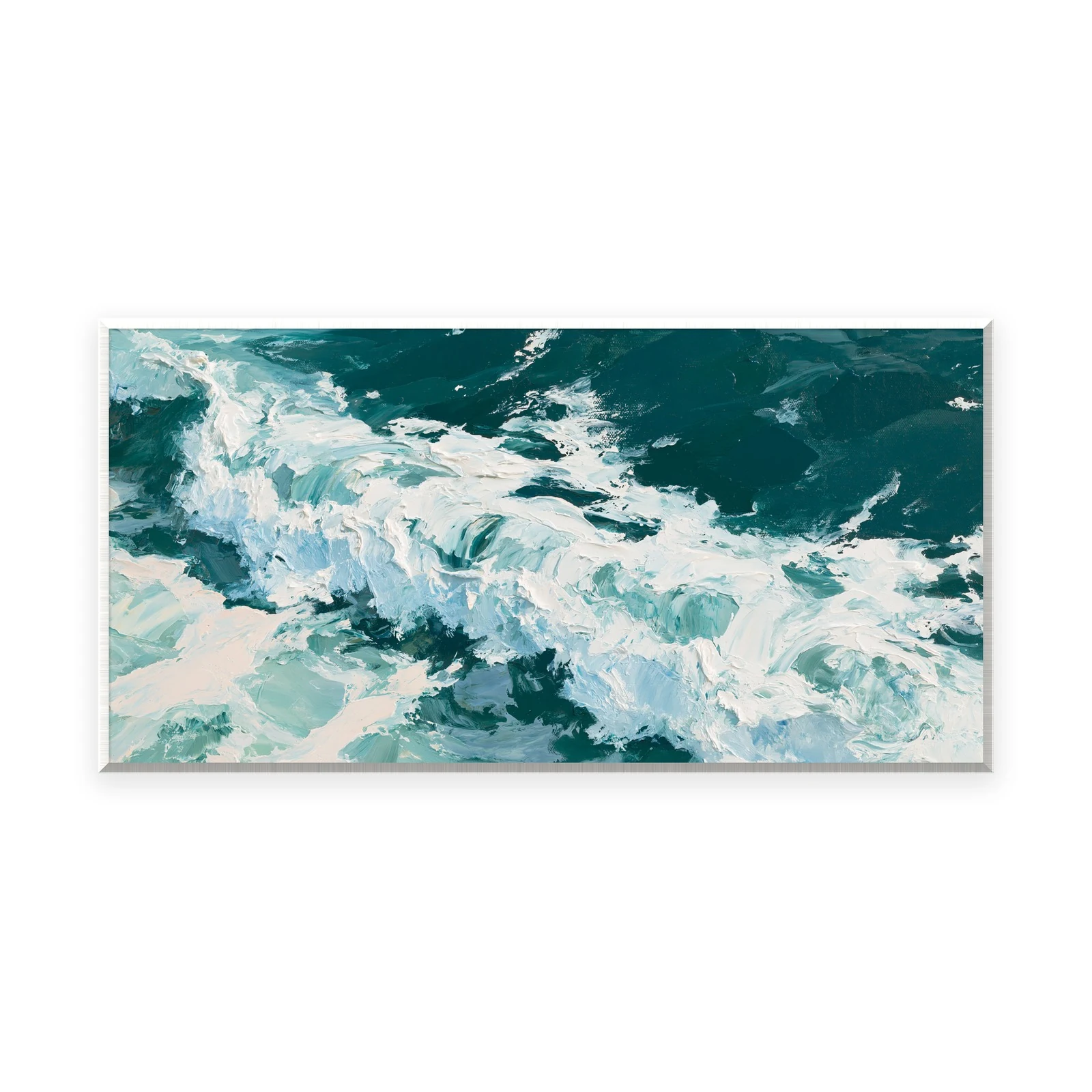
Deep water, foam and open sky in teal and white. A long horizontal is the safest choice above a low sofa, because it copies the shape of the furniture.
We do not paint rising-sun flag imagery, and we do not treat Buddhist statues or altar objects as decoration. Enso and brush strokes we paint as brushwork on canvas, not as religious objects. If you want true sumi ink on paper by a trained calligrapher, we are not the studio for it.
Ukiyo-e reproductions: what we copy and what we will not
Copyright matters to us, so we paint only work in the public domain. Our rule: the artist died more than 70 years ago and the work was published before 1931, which makes it public domain in the European Union and the United States.
Hokusai died in 1849, and The Great Wave off Kanagawa was published around 1830 to 1832 in Thirty-six Views of Mount Fuji. Hiroshige died in 1858; his Fifty-three Stations of the Tokaido appeared in 1833 to 1834 and One Hundred Famous Views of Edo in 1856 to 1858. Both artists pass, so we paint them. Later shin-hanga artists do not. Kawase Hasui died in 1957 and his work is still in copyright, so we will not paint it. We do not copy living artists or another company’s design.
Our reproductions are unsigned. We add no signature, studio mark or text to the front of the canvas.
Sizing for low furniture and long walls
Japanese and Japandi furniture sits low, so the wall above it is wide and short. A tall vertical canvas fights that shape. A long horizontal one agrees with it.
A useful starting point: make the painting about 60 to 70 percent of the width of the sofa or bed below it, and leave 6 to 10 inches of wall between the furniture and the canvas. Above a low platform bed you can hang lower than in a Western room.
Any size outside our 60 standard sizes is painted to your measurements at the same rate, so if your wall wants 66 by 22 inches, that is what we paint. Single canvases larger than 80 by 60 inches are quoted case by case. For a very long, very narrow canvas, send the numbers first: we will confirm how the stretcher can be built, or suggest two or three panels.
Indigo, sumi black, sage and warm gray
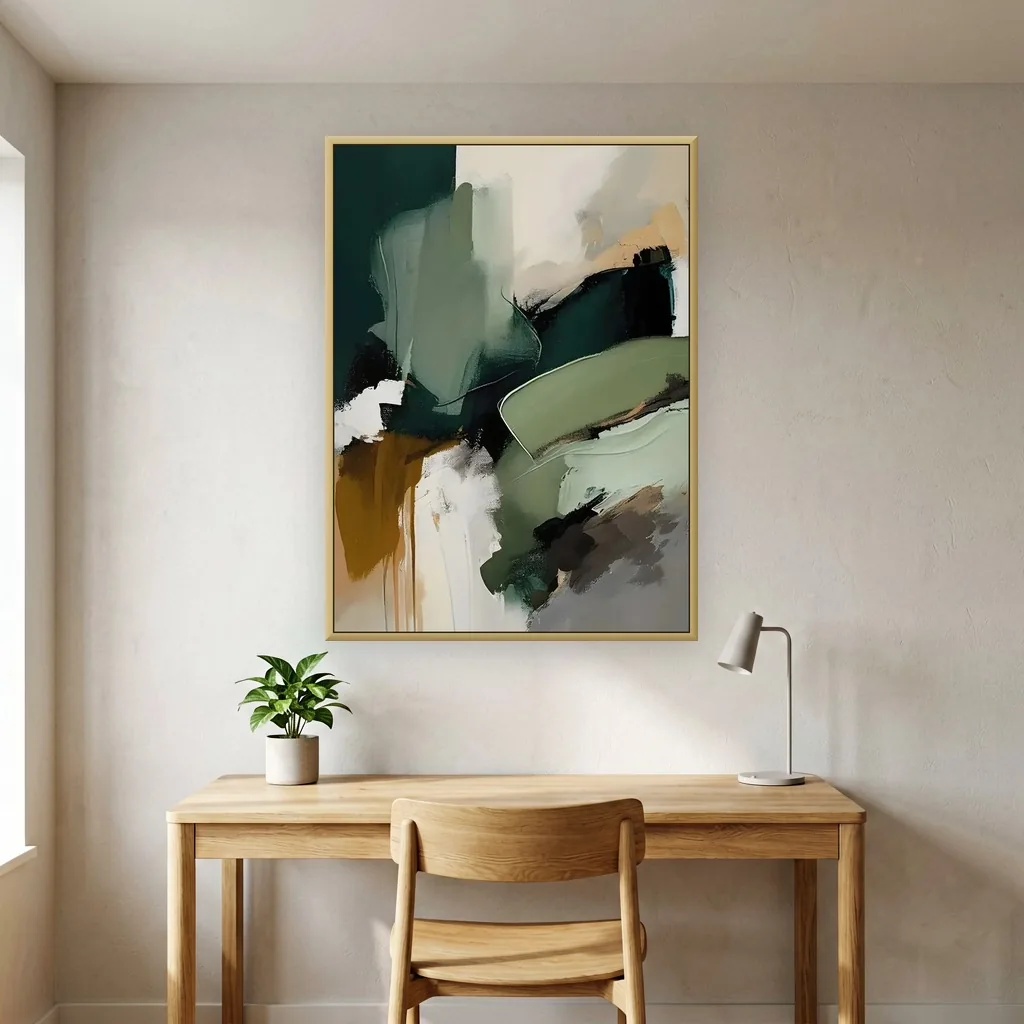
The palettes that sit well in these rooms are narrow: indigo, ink black, sage and olive, warm gray, unbleached white, and one earth tone such as clay. Most of our wabi-sabi and minimalist pieces already sit inside that range.
You do not have to accept the colors as painted. We can recolor any catalog design, for example pushing a beige and terracotta wabi-sabi piece toward warm gray and indigo. We can also match a paint code or fabric sample: we mix the color, photograph it under daylight and send you that photo for approval before we paint.
Sushi restaurants, izakaya, ryokan-style hotels and spas
Mixed designs count together as one order. A restaurant that wants one wave piece, two sakura panels and five small textured pieces is buying eight pieces, so it all sits on one rate. Trade pricing starts at one piece, improves at 6 and again at 21.
Plan backwards from your opening date. Production is 10 to 15 business days for 6 to 20 pieces and 15 to 20 for 21 to 50. Pieces 36 by 48 inches and larger, heavy texture and multi-panel sets sit at the top of their band, because thick paint has to dry.
Rolled canvas is the cheapest way to ship above about 20 pieces, and a local framer can stretch or frame near your site. Heavy texture is the exception: rolling thick impasto is not recommended, so those pieces ship stretched or framed. Freight is quoted separately at cost with no markup. More on our hotel page. If the delivery address sits in Japan or anywhere else in Asia, our Asia shipping page covers how those orders travel.
Renting, or a wall you cannot drill
Many apartments in Japan, and city rentals elsewhere, do not allow a hole in the wall. Rolled canvas solves most of that. We ship the painting in a tube and a local framer stretches or frames it, keeping it light enough for picture rail, a wall-safe strip or a slim shelf.
Leaning also works, and it looks deliberate in these rooms. A framed canvas resting on the floor, or a small piece propped on a low cabinet, needs no fixings. If you need a smaller parcel than a standard tube, ask us before you order.
Did not find what you like? Send us what you like and we paint it
The catalog is a starting point, not a limit. Send the image and we paint it by hand at your size.
- Your own photo: Fuji from your trip, a Kyoto garden, a maple in autumn.
- A public domain print at your size, such as The Great Wave off Kanagawa.
- A Pinterest board or screenshot. We will say if any of it is someone else’s copyrighted design before we quote.
- A digital file, a render or an AI-generated image.
- A paint chip or fabric sample, when the color is the important part.
- Several photos combined into one composition, or a wabi-sabi design resized and recolored.
On commissions we send progress photos while the piece is being painted, so you can redirect us early.
How ordering works
- Send the details Sizes, motif, finish and quantity, through the quote form. One piece or fifty.
- We reply WhatsApp replies are usually immediate; email replies usually arrive within 12 hours.
- Painting Progress photos on commissions. Payment is usually 50 percent deposit, balance before release.
- Approval photos We photograph every finished canvas. Nothing leaves the studio until you approve.
Good fit
- You want a painted surface, not a print, in a mostly empty room.
- Your wall needs a size nobody stocks.
- You are fitting out a restaurant, spa or small hotel.
Not a fit
- You need it this week. Painting takes 7 to 10 business days at best.
- You want a copy of a living artist’s work.
- You want true sumi ink on washi paper by a trained calligrapher.
Questions people ask
Can I get The Great Wave as a real hand-painted painting instead of a print, in a size that fits above my sofa?
Is it legal to reproduce Hokusai and Hiroshige?
Oil or acrylic?
Can you paint an enso circle or a large brush stroke for a meditation room?
I rent and cannot drill. Can you send the canvas rolled?
Do you sign the painting or add anything to the canvas?
How long does a set of 6 to 20 paintings for a ryokan-style hotel take, and how does it ship?
Can you match the indigo or sage color in my room?
No minimum order. WhatsApp replies are usually immediate; email replies usually arrive within 12 hours.